


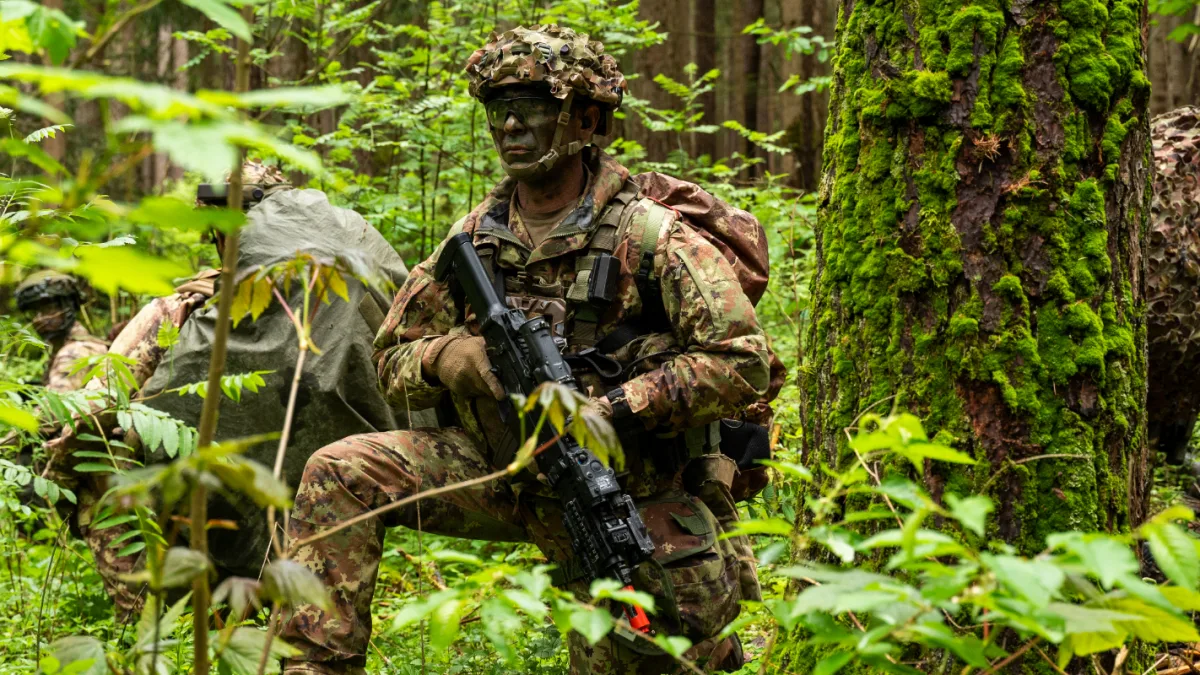

In recent years, the way of fighting has changed faster than our procedures: affordable drones, electronic disturbances, widespread sensors, resilient communications, software that updates in weeks. In this context, the quality of equipment “here and now” is not a detail: it is a survival factor.
And here it must be said without mincing words: if we don't change now, the slowness, inertia, and dependence on entrenched mechanisms will be paid with blood. First with the lives of our soldiers, then — in worse scenarios, where threats get closer and more aggressive — also with the safety of Italians. A system that puts procedures, interests, and habits before operability is not just inefficient: it is dangerous.

The point is not “Italy against abroad”. The point is who leads. And here it is useful to recall the words of Gen. Luciano Portolano: the industry must act as a partner, that is, support, not lead the Defense choices.
Within this framework, we continue to support that Guido Crosetto is setting the most correct direction: putting operability at the center and pushing to modernize rules, times, and mindsets. For this reason, in our opinion, he is the best Minister of Defense the Republic has ever had.
The problem: industrial “subordination” and choices that come late (or cost too much)
1.1 A bias that weighs on decisions
In Italy, military purchases often follow long and complex paths. Controls are important, but the side effect is known: there is a tendency to favor established supply chains and “system” solutions, often national, even when speed is needed or better alternatives are already available.
1.2 Aggressive offer, capabilities not always aligned
It happens that the national industry “proposes itself” even in areas where it is not really ready or competitive. The risk is threefold:
- requirements that adapt (even unconsciously) to those already inside;
- times and costs that become “normal” out of habit;
- postponement of the adoption of effective solutions already available elsewhere.
1.3 Quality must not be indisputable
A healthy system allows departments to say: “it doesn't work”, “it's not safe”, “it doesn't withstand real use”. If instead contesting a product becomes difficult or “uncomfortable”, a vicious circle is created: bureaucratic calm wins, not quality. And in the military field, this is a serious drift.
1.4 Start-ups and SMEs: many ideas, little scalability
Italy has creativity and skills, but struggles to grow new dual-use/defense realities within public mechanisms. Result: prototypes that do not become equipment, innovation that remains on the sidelines, and chronic dependence on the usual channels.

1.5 The decisive courage: buy abroad when needed, especially to save lives
If a foreign solution is more reliable and available sooner (anti-drone, tactical EW, resilient communications, sensors), it must be bought. Supporting the national industry is right, but it cannot be worth more than the safety of soldiers.
And doors must be closed to opaque markup dynamics (rebranding, intermediations, “nationalizations” in appearance): if there is real national added value, it is measured and paid for; if not, it is not paid.
The drone case: excellent work within the Army, but evident difficulties in “taking off”
The drone project in the Army is the perfect snapshot of the problem. On one side, there is a real and modern push: the Chief of Staff of the Army, Gen. Carmine Masiello, has placed the issue of drones and anti-drone at the center, supporting experiments and operational demonstrations.
On the other side, however, it is evident that the drone capability struggles to become widespread, stable, and rapid. Not because of a lack of internal vision, but because negative external influences intervene to slow down:
- procedural delays,
- rigidity of procedures,
- supply chain pressures,
- priorities that fluctuate,
- interests that push choices not always optimal.
The point must be said with respect but without ambiguity: these influences damage the extraordinary work done by Gen. Masiello and the Army, and risk turning an urgent need into an endless path.
And the price is not theoretical. If the drone project does not really “take off”, and does not become a widespread, trained, and stably maintained capability, we send the units on the ground with a gap that others fill every month. That gap, in war and high-risk missions, translates into losses. It is not rhetoric: it is the brutal logic of technological asymmetry.

Electronic warfare: today too “niche”, while adversaries use it at all levels
On electronic warfare, the problem is even more clear-cut. The Army has specialist units and important skills, like the 33rd EW Regiment.
But the point is not “having an excellent unit”: the point is that EW cannot remain a capability for the few.
Today, adversary armies employ electronic warfare more extensively: from the strategic level to the tactical one, down to the smallest units. In many recent wars, the electromagnetic spectrum has become a daily battleground: disturbances, denials, deceptions, hunting for data links and drones.
If EW remains confined to a few “specialist islands”, we risk fighting “unarmed” in the spectrum: when you lose communications, navigation, data links, and drone control, you also lose time, coordination, and protection.
And here a simple truth applies: not changing does not mean staying the same, it means falling behind. And falling behind, in this sector, means putting Italian lives at risk.
What politics must do: 8 concrete (and verifiable) moves
- Truly apply the Portolano principle: industry as a partner, not a leader.
- Mandatory international benchmarking for critical capabilities (performance, costs, times).
- Independent and realistic tests before large-scale purchases.
- “Life-saving” rapid acquisition for drones, anti-drone, tactical EW: buy soon what is needed soon (with serious controls, but without paralysis).
- Open and modular architectures, especially on software and sensors: avoid supplier dependencies.
- Institutional protection for those who report problems on safety and performance: technical criticism must be a duty, not a risk.
- Real path for start-ups and SMEs: from prototype to contract, if operational tests are passed.
- Transparency on costs and intermediations: total cost, real times, foreign/national components, and measurable added value.

Conclusion
If we want a more effective and safer Army, the criterion cannot be “who produces it”, but “how much it protects, how well it works, when it arrives”. And Portolano's phrase must be turned into an operational rule: the industry must support, not lead.
Because here the stakes are enormous: without a real change, this entrenched system will continue to slow down decisive capabilities (drones, anti-drone, EW), and that delay will cost lives: first of our soldiers, and potentially also of Italian citizens in worse scenarios. Modernization is not a luxury: it is a form of national protection.
And it is precisely here that the quality of politics is measured: in knowing how to break inertia and pressures, and in giving continuity to those who are doing serious work within the Army — like Gen. Masiello on the drone front — preventing external factors from slowing down their effect.



Comments
No comments yet. Be the first!