


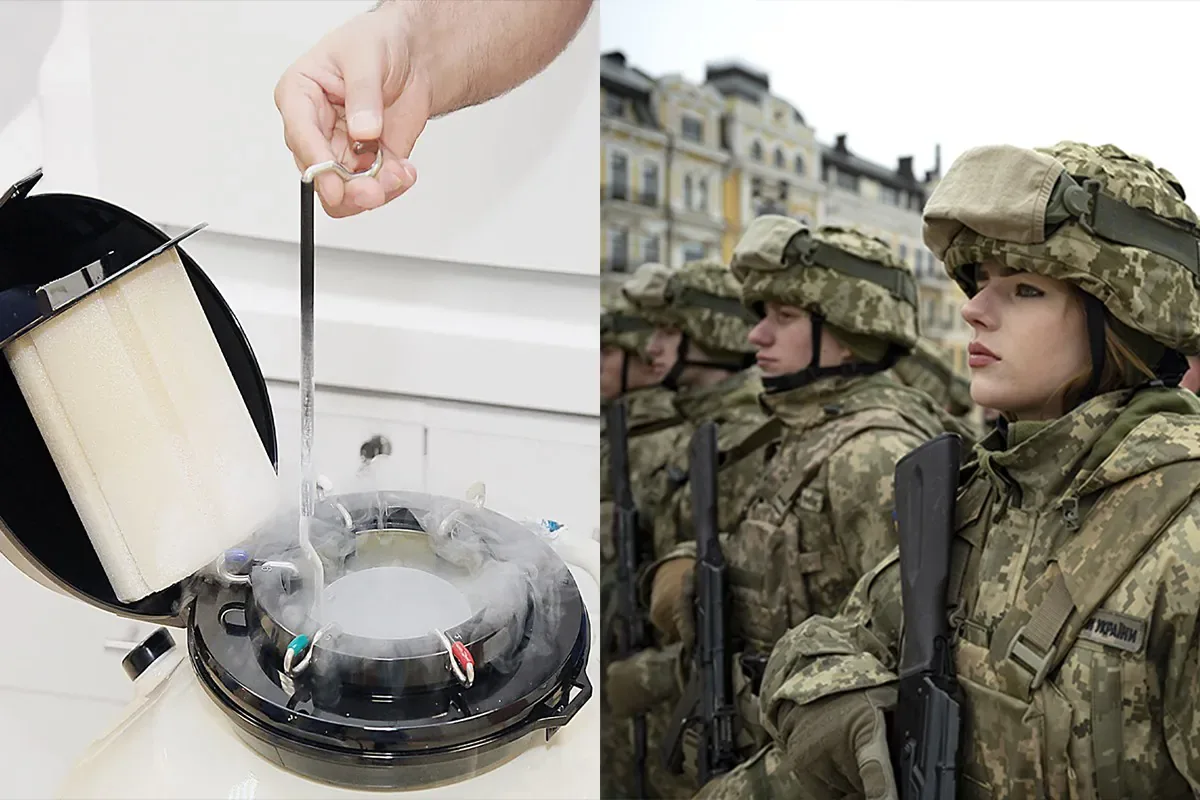

While the front holds with weapons, Ukraine is fighting a second silent but equally decisive war: the one against demographic extinction. In a country where the number of deaths triples that of births, the government has decided to invest in a form of "biological insurance" for the future: free cryopreservation for its soldiers.
An Unprecedented Demographic Emergency
Ukraine is experiencing a negative spiral that has roots well before the 2022 invasion, but which the conflict has turned into an abyss.
- The population collapse: From 52 million in 1991 to less than 36 million today. The projections of the Academy of Sciences are bleak: there is fear of dropping to 25 million by 2051.
- The impact of the war: Male life expectancy has plummeted from 65.2 to 57.3 years. It is estimated that between the fallen, wounded, and missing, the figure approaches 600,000 units.
- The exodus: Over 5 million Ukrainians are abroad; a significant portion (up to 2.7 million) may never return, depriving the country of the workforce needed for reconstruction.
Kiev's Response: State Cryopreservation
Since 2023, the collection and preservation of gametes (sperm for men, oocytes for enlisted women) have become a service funded by the public budget.
The cost of procedures is prohibitive for many families, which is why state intervention has been crucial:
- Male sperm: 150-300€ for collection, plus 50-100€ annually for preservation.
- Female oocytes: The stimulation and collection cycle costs between 1,000 and 1,500€, in addition to the costs for possible assisted fertilization (over 2,500-3,000€).
Initially, the regulation provided for the destruction of genetic material in case of the donor's death. Today, a legislative revision allows for free preservation up to three years after death, allowing widows to proceed with medically assisted procreation, provided there is prior written consent.

Beyond the Front: Physical and Psychological Traumas
The program does not only look at those who fall in battle. Many soldiers return from the front with disabling injuries or psychological traumas that cause impotence. In these cases, the frozen sperm before the mission represents the only possibility for the couple to have children, ensuring family continuity that the war would risk breaking forever.
Ethical Dilemmas and International Comparisons
Ukraine is not alone in this reflection, but it moves on a minefield from a bioethical point of view.
- The Israel model: Tel Aviv goes further, discussing a law that would allow post-mortem collection (within 24 hours of death) even without explicit consent, at the request not only of widows but also of the parents of fallen soldiers.
- The criticism of "planned orphans": While on one hand, there is talk of lineage continuity, on the other hand, bioethicists and critics raise the issue of the rights of the newborn, destined to come into the world as a "planned orphan".
In summary: The Ukrainian initiative is not a simple health service. It is an extreme attempt to preserve the "human capital" of a nation. While bombs destroy infrastructures, Kiev seeks to save the genetic code of its next generation.





Comments
No comments yet. Be the first!