


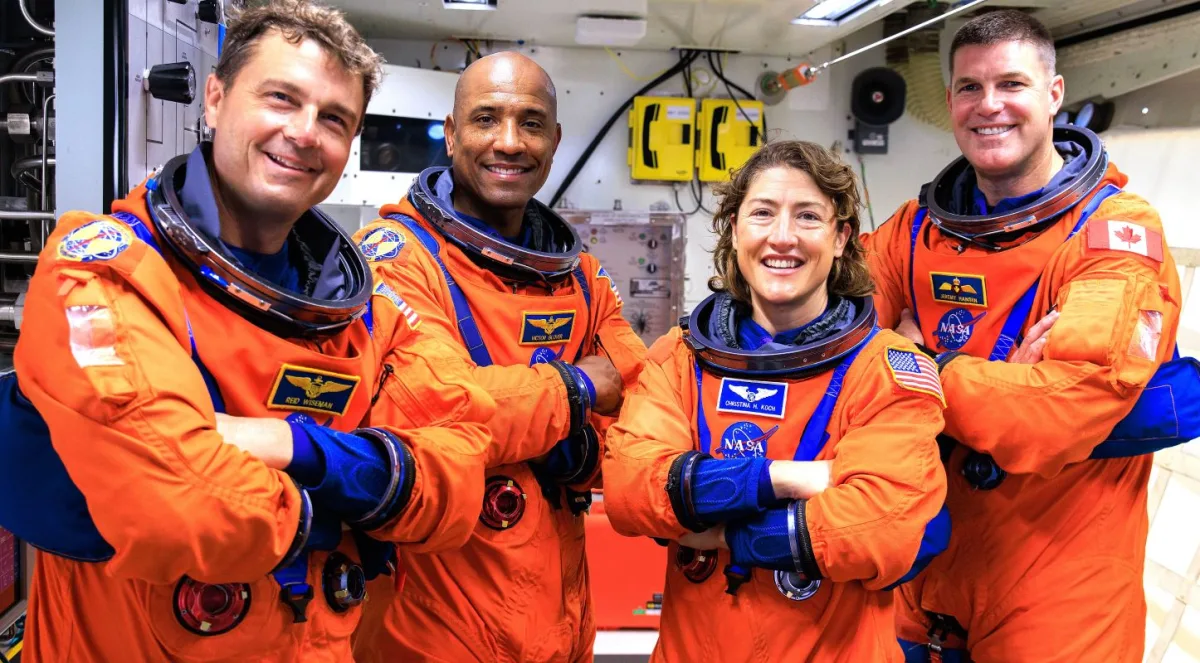

The dream of returning to the Moon is becoming increasingly concrete. NASA has announced that the Artemis II mission, the first crewed mission of the new lunar program, will be launched on February 5, 2026. A date that marks the beginning of a new phase in space exploration, with the stated goal of bringing humans back to the lunar surface by the end of the decade.
The Artemis II Mission: A Flight Around the Moon
Artemis II does not involve a landing, but it will be crucial for testing the Space Launch System (SLS) and the Orion capsule with astronauts on board. During the mission, the crew will orbit around the Moon on a journey of about ten days, verifying all the necessary procedures to ensure safety in future landing missions.
The selected astronauts, including prominent figures like Reid Wiseman and Christina Koch, will be tasked with collecting fundamental data on the resilience of onboard systems and the impact of lunar radiation.

NASA has accelerated the timeline for several reasons. Firstly, international competition: China has already announced its crewed mission to the Moon by 2030, and Russia, despite difficulties, continues to invest in its space programs. India, fresh from the success of the Chandrayaan-3 landing, has also emerged as a new player in the global space landscape.
Moreover, there is a clear economic and strategic interest. The Moon is considered a “logistical platform” for deeper exploration, starting with Mars. Its resources, particularly helium-3 and water ice deposits in polar craters, could prove crucial for supporting permanent bases and long-range missions.
The Artemis program aims not only to repeat Apollo's achievements but to build a stable presence. Artemis III, scheduled for 2027, is expected to mark the return of astronauts to the lunar surface, while subsequent missions will focus on establishing semi-permanent bases. In parallel, the Gateway project – an orbital station around the Moon – will serve as an intermediate platform between Earth and the lunar surface.
International participation is a cornerstone of the program: the European Space Agency (ESA), Japan (JAXA), and Canada (CSA) contribute with modules, technologies, and astronauts, consolidating an unprecedented network of cooperation.
The Challenges to Overcome
Despite the enthusiasm, the challenges remain considerable. The program's costs are enormous: it is estimated that by 2026 the budget will exceed 90 billion dollars. Additionally, NASA will need to demonstrate that the new systems are reliable, following the delays and technical difficulties that have characterized the development of the SLS and the Orion capsule.
The safety of the crew is another major critical point. The Artemis missions expose astronauts to much more intense cosmic radiation compared to missions in Earth's orbit. For this reason, the tests of Artemis II will be crucial to verify the protection of the systems and the physical resilience of the crews.
The return to the Moon also has a strong symbolic value. More than fifty years after the last Apollo mission, the United States wants to reaffirm its leadership in space exploration. In a context of geopolitical competition with China, the conquest of space returns to being a tool of soft power and international influence.

At the same time, the Artemis II mission aims to reignite public enthusiasm and inspire new generations of scientists, engineers, and astronauts. Just like in the 1960s, the lunar challenge becomes a catalyst for technological innovation and scientific progress.
A Look to the Future
If Artemis II concludes successfully, 2026 will be remembered as the year that relaunched the race to the Moon. But it will only be the beginning: Artemis III and subsequent missions will lay the groundwork for a stable human settlement.
NASA's vision is clear: the Moon as a springboard to Mars and beyond. And as humanity prepares to take new steps into the cosmos, the date of February 5, 2026, will remain etched as the day the lunar adventure became a reality once again.



Comments
No comments yet. Be the first!