


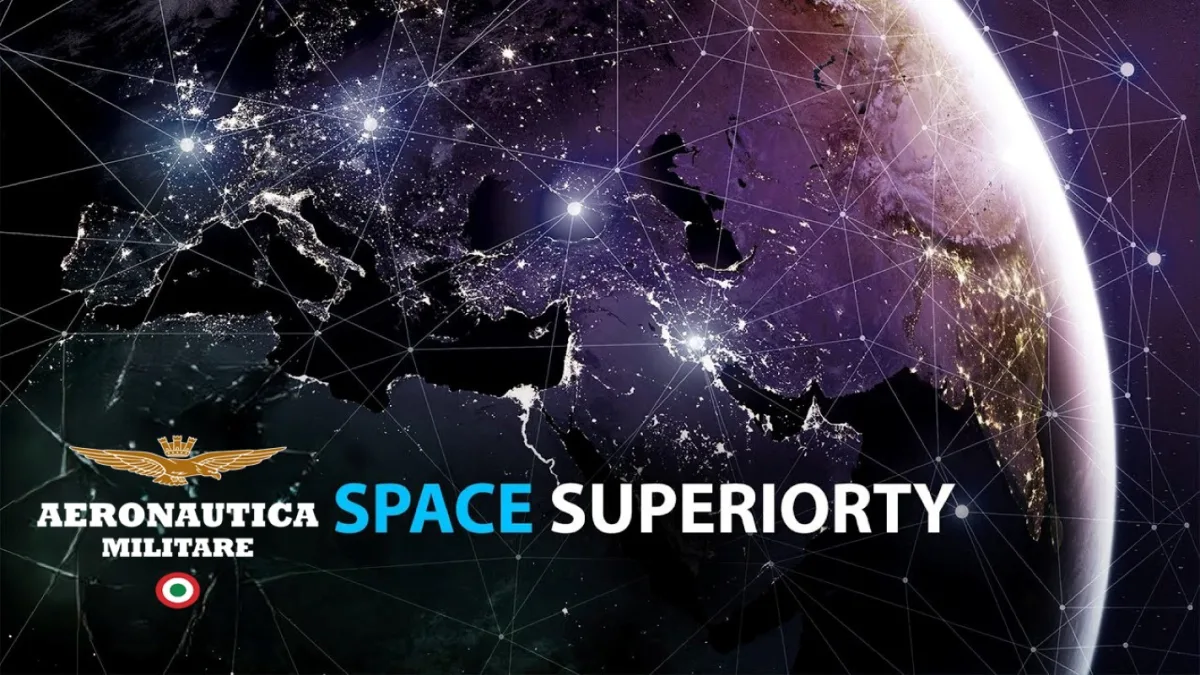

Brussels, January 27–28, 2026 – European security increasingly relies on Space. This was the strong message that emerged at the 18th edition of the European Space Conference, the main continental event dedicated to policies, programs, and capabilities in the space domain, which brought together EU institutions, member states, Armed Forces, industry, and academia.
In this context, the participation of the Italian Air Force represented a particularly significant moment to share the national vision at a time when Space is now recognized as an operational domain and an essential enabling factor for collective security and defense.
The Italian delegation included the Chief of Staff, Antonio Conserva, and the Commander of the Aerospace Operations Command, Luca Maineri, who participated in the panel “Conversation between Space Commanders”. During the discussion among commanders, the Italian approach to space operations was highlighted: multi-domain integration, inter-institutional coordination, and strengthening synergies with European and allied partners.

From “Space Awareness” to “warfighting domain”
In the plenary session on January 28 – which included speeches by Vanessa Matz, ESA Director General Josef Aschbacher, and European Commission Executive Vice President Henna Virkkunen – General Conserva's intervention provided a clear overview of the strategic context: the evolution from a phase of simple “Awareness” to the recognition of Space as an actual warfighting domain.
Two critical issues were particularly highlighted:
- Ambiguity of threats, with hostile activities in the electromagnetic and cyber spectrum (jamming, deception) and increasingly opaque conduct in orbit, including approaches and maneuvers that jeopardize the stability and security of European strategic infrastructures;
- Orbital congestion, which now makes Space Safety and Space Security inseparable: the safety of space “flights” is directly linked to the defense of assets.
The European ambition: survival or “Space Superiority”
The Chief of Staff then outlined priorities and lines of action, posing a question that will weigh on European choices in the coming years: should the Union limit itself to ensuring the survival of satellites or aim for a more assertive “Space Superiority”? In this perspective, the need for reflection on the development of proprietary deterrence and counter-space capabilities was emphasized, carefully considering the risks arising from excessive dependence on third parties.
In the framework of integrated space security, the centrality of the transatlantic relationship and the need for a structured and continuous dialogue with NATO to define common standards and ensure full interoperability were reiterated.
In conclusion, General Conserva summarized the strategic balance that the new phase imposes: readiness without provocation, resilience without fragility, deterrence without escalation. A message that links operational effectiveness to European political and industrial cohesion: the future of space security will belong to those who can understand more quickly, endure longer, and act united.

The role of the Air Force in Defense space governance
In the context of national space governance, the Italian Air Force confirms its role as Lead Service for the space domain: developing future capabilities, protecting orbital infrastructures, and defining shared operational standards. The action continues in synergy with national and international Ministries and Agencies, also in a dual-use perspective, to strengthen the resilience and credibility of the Country System in a scenario where Space is no longer just a support environment, but a determining factor of security.



Comments
No comments yet. Be the first!