


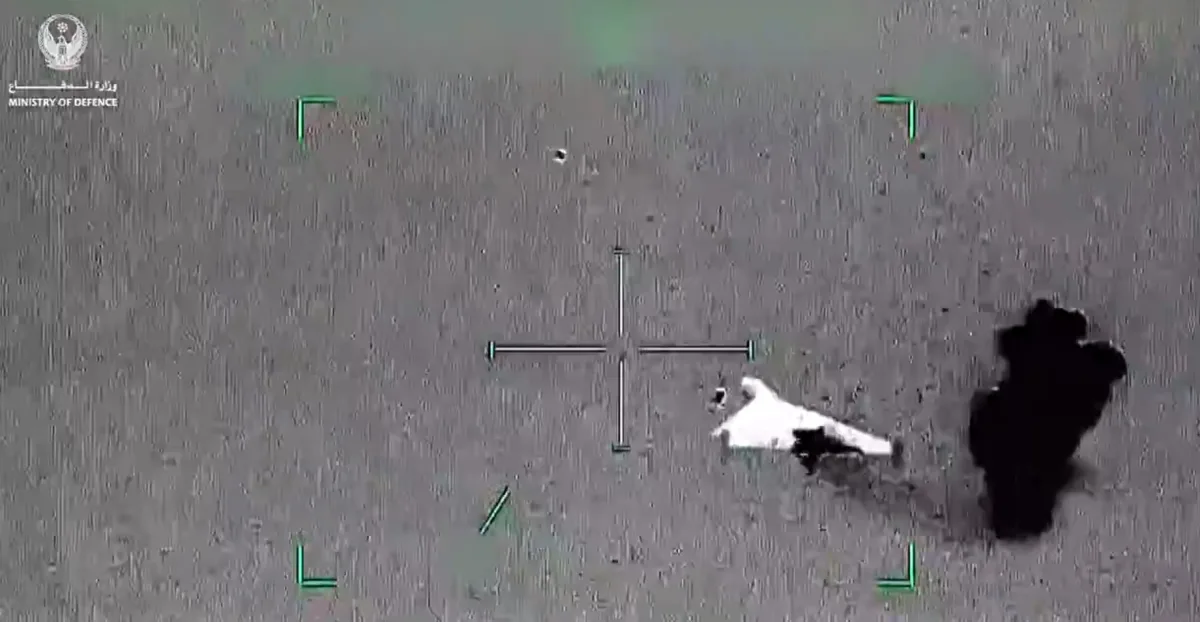

The United Arab Emirates announced that they have repelled a massive attack conducted with kamikaze drones, cruise missiles, and ballistic missiles attributed to Iran. According to the Emirati Ministry of Defense, the air defenses detected 1,422 UAVs, managing to intercept 1,342 before they reached their targets.
The official report also includes eight cruise missiles, all destroyed, and 238 ballistic missiles identified during the offensive. Of these, 221 were reportedly shot down, while 15 fell into the sea and two hit the national territory. Numbers that show the scale of the attack and the pressure exerted on the country's air defense network.
The military significance: quantity matters too
The episode demonstrates that in modern conflicts, having advanced systems is not enough: there is also a need to handle attacks in mass. This is the essence of the title: not only quality, but also quantity. Intercepting a few targets is one thing, stopping a swarm of over fourteen hundred drones along with various types of missiles is a much more complex challenge.
Drones similar to the Iranian Shahed, indirectly mentioned in the footage released by the Emirates, are weapons designed specifically to saturate defenses. They have a low radar signature, are relatively inexpensive, and can be launched in large numbers to challenge radars, interceptors, and command centers. For this reason, modern aerial warfare is increasingly measured by the ability to withstand the volume of the attack, not just the sophistication of individual systems.
The message from the Emirates and the lessons of the conflict
With the video released by the Armed Forces and the note from the Ministry of Defense, Abu Dhabi aimed to send a clear message: security and national sovereignty are non-negotiable. The images of the interceptions are meant to show that the Emirates have a multi-layered defense capable of responding against drones, cruise missiles, and ballistic missiles.
However, an important element remains: part of the threats still managed to breach the defensive shield. This confirms that even the most advanced systems can be pressured by saturation attacks. The strategic lesson is clear: in today's Middle East, superiority depends not only on technological quality but also on the ability to sustain a high-intensity and high-volume confrontation.
I can also make it in a more concise news site format, with three stronger subtitles and a more professional style.



Comments
No comments yet. Be the first!