


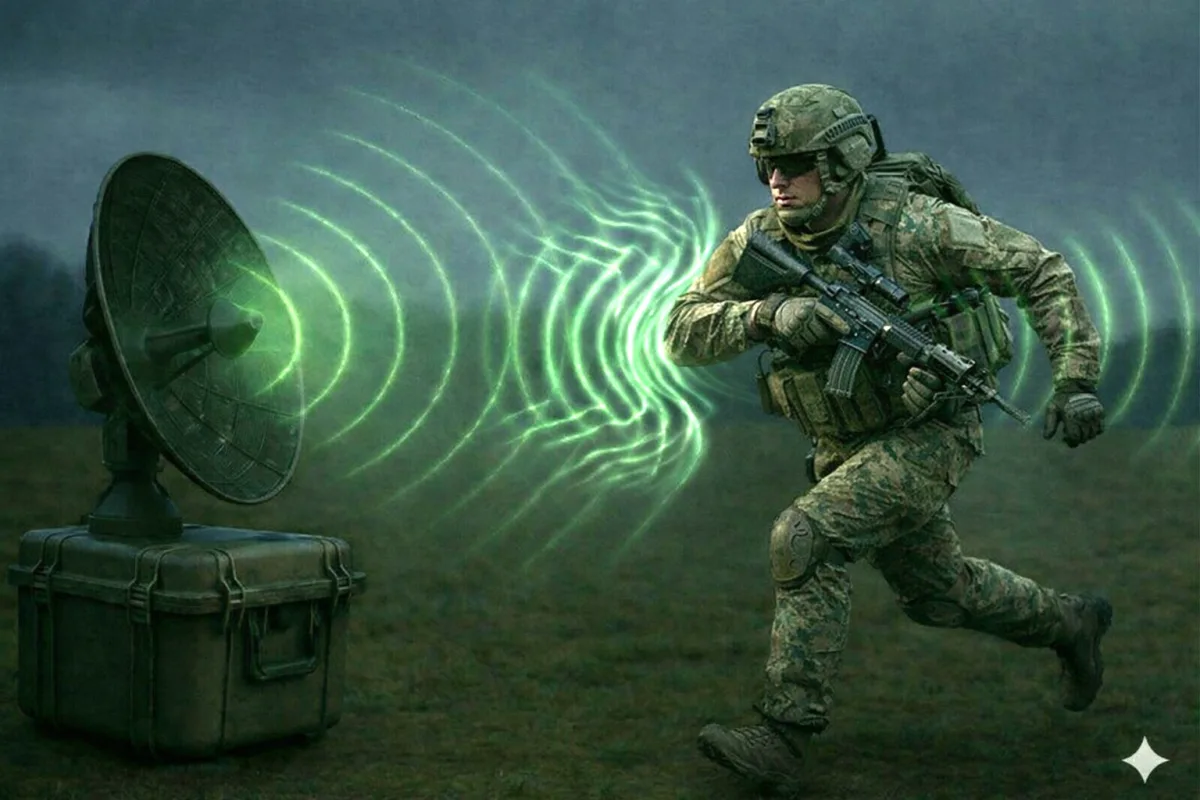

Making an object “untraceable” does not mean making it disappear from sight, but reducing its detectability by radar, sensors, and communication systems. A research group at the KAIST (Korea Advanced Institute of Science and Technology) in South Korea is working in this direction: two professors from the Department of Nuclear and Quantum Engineering have developed a technology based on a liquid metal composite ink, called LMCP (Liquid Metal Composite Paste), designed to absorb, modulate, and shield electromagnetic waves.
The idea is to create coatings and surfaces capable of controlling how an object interacts with electromagnetic signals: if a radar “reads” less reflection or finds an altered signal, the object may be more difficult to detect.

Why LMCP is Different from Traditional Metals
To achieve effective concealment, one must intervene directly on the surface of the object, but conventional metals are rigid: if stretched or bent beyond a certain limit, they break or lose electrical continuity. This makes it complicated to apply on technologies that need to adapt to the human body or change shape, such as robots and wearable devices.
The KAIST team, however, has created a liquid metal ink that maintains conductivity even when stretched up to 12 times its original length. The material, while remaining “soft” and rubbery, retains properties typical of metals. The reason lies in the drying process: the liquid metal particles in the ink tend to spontaneously bond with each other, forming a lattice structure that combines elasticity and strength.

Applications: E-skin, Wearables, and Defense
In recent years, liquid metal has been identified as an important candidate for flexible electronics: sensors, electronic skins, stretchable displays, and batteries. In the case of LMCP, a key point is also the ease of use: the ink can be printed or applied with a brush and then left to dry, without complex processing.
According to the researchers, LMCP could enable coatings capable of changing behavior while moving. Unlike many traditional stealth materials — often rigid and tuned to specific frequencies — here the electromagnetic properties can vary with the stretching or bending of the material. In practice, the configuration of the particles changes during movement, and this can alter interaction with different radar frequencies.
Printed on an elastic surface, the ink forms a mesh that can behave like a metamaterial: an artificial structure designed to manipulate electromagnetic waves, for example by allowing them to pass beyond the object or absorbing them. The mentioned applications include robotic skin, body-mounted wearable devices, and traceability reduction systems in the defense sector. Thus, it is not about invisibility “to the eyes,” but a possible step forward towards surfaces capable of actively hiding moving objects from modern detection systems.






Comments (1)