


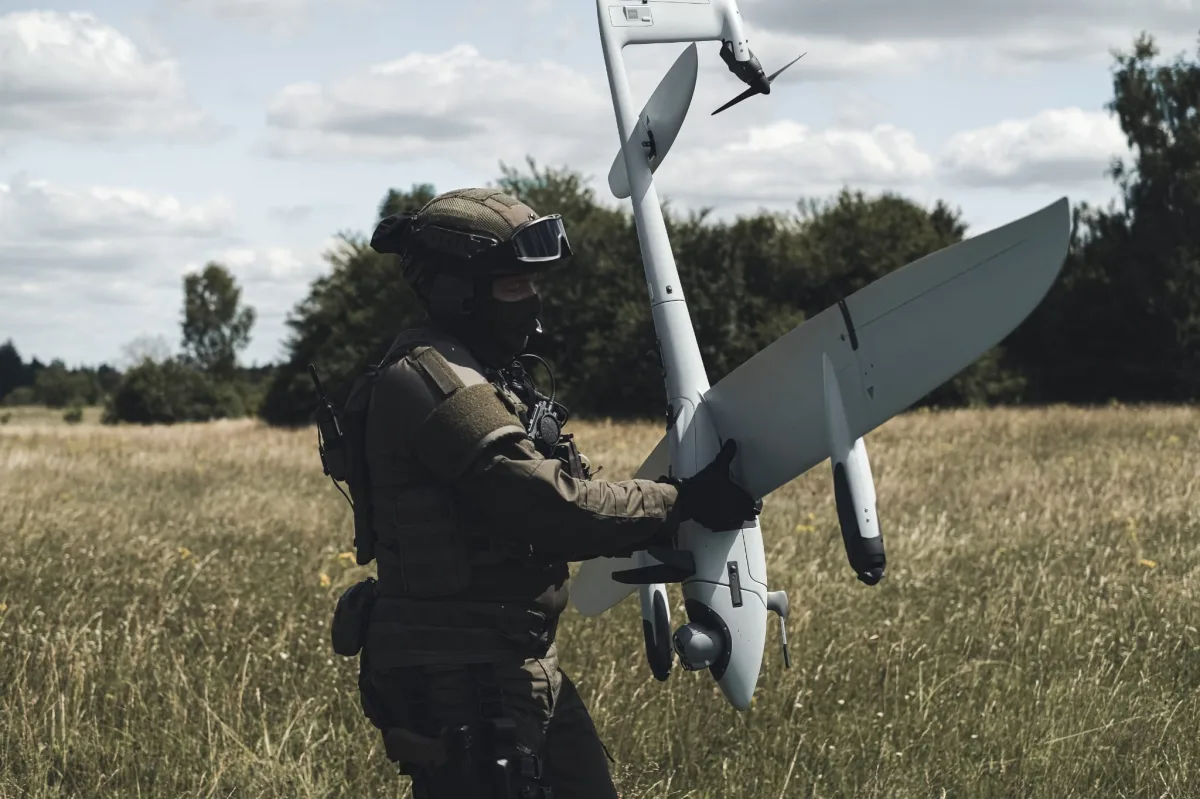

In recent years, Europe has visibly accelerated the production of light drones: from pocket-sized micro-UAVs used by patrols and police forces, to mini-UAVs (often hand-launched or catapulted) for reconnaissance, surveillance, and tactical support. Two drivers are pushing this: strongly growing military demand and the need for industrial sovereignty, meaning reducing foreign dependencies on components and production lines.
Micro and mini drones: what are we talking about. There is no single definition, but to understand: Micro are very light, easily transportable platforms (often multirotor), designed for short-range observation; Mini, on the other hand, are light but more tactical drones, with greater autonomy and payload, often fixed-wing or VTOL.

The main European “factories”: who really produces (and where)
Delair (France, Toulouse) – industrial-scale production: a textbook case when it comes to factories, with a dedicated plant, structured processes, and series capacity; Delair represents a European model of transitioning from prototype to repeatable batch, typical of mini-UAVs for ISR and governmental uses.
Quantum Systems (Germany) – rapid scaling and mass production logic: one of the European names most clearly pushing on scale, also thanks to partnerships and production initiatives linked to the operational context of recent years; here the key concept is the transition to “large” numbers, not just the “best” product.
Threod Systems (Estonia) – verticalization and internal production: a Baltic player with a defense setup, more compact than large groups but with a very “industrial” approach (internal production and subsystem integration), typical of those who want to control the supply chain and timing.

Sky-Watch (Denmark) – tactical mini-UAS: strong recognition in the military mini segment, with solutions designed for real use; here the strength is not so much “making a drone,” but having a system already calibrated to operational requirements, robustness, maintenance, and procedures.
C-Astral Aerospace (Slovenia) – production and assembly in the EU: an important example because it shows how even small countries can keep the development, production, and assembly of fixed-wing mini-UAVs in Europe, with an essential but concrete industrial supply chain.
Edge Autonomy (Latvia, Riga) – large European plant: significant for its size and industrial presence on European soil; when there is a “large” plant, it often changes the ability to ensure continuity, spare parts, and production ramp-up.
Evolve Dynamics (United Kingdom) – domestic production and rapid iteration: in the micro/mini segment, many European actors are more “engineering-driven” than “factory-driven”; here the value is the ability to quickly update (software, links, resistance to disturbances) and deliver systems that evolve with the operational context.

In summary:
- France: aerospace supply chain and “classic” plants (e.g., Toulouse area).
- Germany: industrialization and scaling (automation, production closer to “mass”).
- Baltic and Northern Europe: lean, verticalized players, often very close to military requirements.
The real watershed is no longer just the quality of the drone, but the ability to produce in short times, ensure spare parts and maintenance, quickly update against countermeasures and jamming, and increase volumes without collapsing on the supply chain and testing: in other words, production is not a detail, it is part of the weapon system.

Final reflection: and Italy?
Here lies the point that deserves a national reflection: it's good that there is increasing talk about training, procedures, units, and operational capabilities, because without doctrine, drones risk remaining “expensive gadgets”. But the real question is another: where is the Italian micro/mini industry really? The risk, in fact, is to build an excellent employment capacity while relying on a weak production capacity.
Before entering the proposals, it is worth setting three key points:
1) Widespread skills, but little scale
The skills are not lacking: in Italy, there is design, sensors, software, and applications. What appears more fragile is the leap towards the factory, meaning the ability to have:
- replicable lines and processes
- quality and industrial certifications
- volumes and delivery continuity
- resilient supply chain (critical components, links, payload)
Without scale, we remain an ecosystem of excellent prototypes and “small batches”.
2) The risk: large users, small producers
In the short term, it may be understandable to purchase abroad (or integrate non-Italian platforms) for operational urgency. In the medium term, however, this can become a dependency:
- updates
- spare parts
- critical components
- evolution against threats (EW)
remain outside national control.
3) “Making a system” is the key word (but not enough)
Dozens of disconnected initiatives are not needed: resources need to be concentrated on a few measurable objectives, becoming capable of serial production, not just demonstrating.

A constructive provocation: how to change course (and why it matters)
If Italy wants to count in the European micro/mini segment, practical choices are needed, not slogans:
- Multi-year purchase programs (not one-off), to invest in lines and people
- Laboratory units/ranges for testing and validation with rapid cycles, “monthly” and not “biennial”
- Component supply chain: radio links, payload, resilient navigation, and European/Italian supply chain where possible
- Consolidation: help 2–5 entities become real “factories”, without dispersing resources on too many micro-players
- Real dual use: increase volumes also in the civil sector (infrastructure, emergency, agriculture), so that production does not depend solely on occasional orders
In summary, Italy risks training and using drones better and better (good), but producing little on scale (problem): the question that should guide the national discussion is clear, do we want to remain clients of foreign technology or become European producers in the segment that is booming?



Comments
No comments yet. Be the first!