


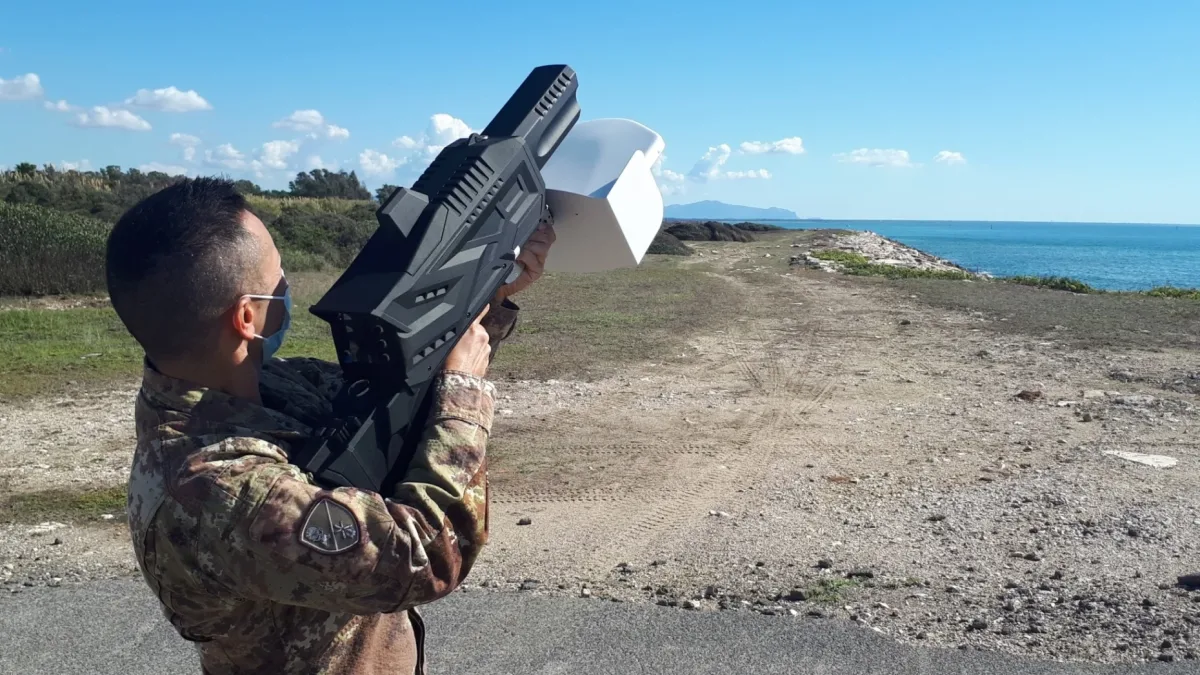

The threat of small drones has grown faster than procedures, budgets, and decision-making chains. For this reason, the U.S. Department of Defense has decided to intervene on the organizational level as well, establishing a joint and inter-agency task force dedicated to countering small UAS, with the goal of delivering effective capabilities quickly and at sustainable costs. The most significant novelty is that the structure is led by the US Army: the Secretary of Defense has tasked the Secretary of the Army to formally establish the Joint Interagency Task Force 401, with a very high-level report to overcome fragmentation and duplication.
The message is clear: counter-drone cannot remain a mosaic of parallel initiatives, with divergent requirements and systems that do not communicate with each other. A single point of coordination is needed, capable of uniting skills, programs, and responsibilities, and accelerating testing, integration, and acquisition. In other words, the American approach aims to “create a system” even before “buying systems.”
Why Army-led makes sense: counter-drone is a tactical and close-range problem
The choice of an Army-led setup is primarily operational. Countering small drones, in most scenarios, is a tactical mission: perimeter protection, defense of deployed units, safeguarding bases and infrastructure, securing sensitive areas, and ensuring continuity of operations on the ground. Often it is a “low altitude and short-range” problem, within complex and saturated environments, where decision-making speed matters as much as the quality of sensors.
In this context, a layered defense is needed: detection and classification, command and control, and then various countermeasures (interception, jamming, deception, neutralization) chosen based on context and proportionality. The point is not a single “miraculous” device, but an integrated architecture that can be quickly updated, functioning coherently across departments and theaters. This is where the US Army can act as a natural integrator: it experiences the problem on the ground, can standardize training and procedures, and can lead a chain of experimentation and validation with immediate feedback from the field.

The lesson for Italy: air defense led by Air Force, counter-drone led by Army
The American lesson is not “the Army commands everything,” but separating domains and integrating governance. Transposed to the Italian context, it can become a pragmatic proposal: air defense led by Air Force; counter-drone defense led by Army.
Traditional air defense involves airspace control, large-scale surveillance, integration with national and allied architectures, rules of engagement, and coordination with civilian traffic: areas naturally overseen by the Air Force. Counter-drone, on the other hand, is predominantly proximity and protection of points and forces, often also in cooperation with other administrations when it comes to civilian infrastructure or major events: areas where the Army can lead common requirements, technical standards, and a rapid test–validation–adoption cycle.

To truly work, an Italian model inspired by the USA should have three characteristics: clear mandate, high-level reporting, and real inter-agency component. Clear mandate means assigning the “counter-drone lead” the responsibility of integration and standardization; the “air defense lead” the coordination of the overall airspace framework. High-level reporting means being able to unlock resources and decisions, avoiding rivalries and overly slow processes. Real inter-agency means including, when necessary, those who manage internal security and critical infrastructure, because the drone issue is now hybrid.
In summary: the US Army-led approach to counter-drone is a pragmatic response to the nature of the threat. For Italy, adopting a similar model—Air Force leading air defense, Army leading counter-drone, common coordination and integrated capabilities—can increase speed, coherence, and sustainability over time.



Comments
No comments yet. Be the first!