




CHRISTCHURCH, New Zealand — Despite a recent incident with an Israeli-built drone, the South Korean military is pressing ahead with unmanned technology, including a loyal wingman stealth design intended to accompany the Air Force's new KF-21 Boramae fighters.
The incident occurred on March 17, when a South Korean Army IAI Heron-1 drone veered off the runway during landing at Yangju, subsequently colliding with a parked Surion helicopter. Both aircraft were declared lost, meaning the army has now lost all three of its Herons in accidents.
Nevertheless, the country is under pressure to accelerate its drone plans — and for reasons that go beyond immediate military equipment considerations.
Kim Jae Yeop, a senior researcher at the Sungkyun Institute for Global Strategy in Seoul, told Defense News that South Korea's low birth rate, among the lowest in the world, is becoming a serious issue.
“The number of regular troops in the armed forces, which is currently about 500,000, will most likely decrease to less than 400,000 in the next decade,” he said.
“As a result,” Kim explained, “Seoul is taking active measures to expand the role of unmanned military systems to compensate for the reduction in troops. They can be acquired on a large scale at a lower cost and without risk to lives on missions.”
An important program saw Korean Air unveil a new loyal wingman technology demonstrator — called the Low Observable Unmanned Wingman System, or LOWUS — on February 25.
The turbofan-powered LOWUS stealth, funded by the Defense Development Agency since 2021, was unveiled at the Korean Air Tech Center in Busan. Its first flight is expected this year, ahead of team flight tests between manned and unmanned in 2027.
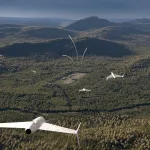
Equipped with an internal weapons bay and resembling the American Valkyrie XQ-58A, Korean Air indicates a length of 10.4m and a wingspan of 9.4m for the aircraft.
As with similar loyal wingman concepts proposed by other major powers, the idea for the drones is to perform missions ranging from attack to surveillance, electronic warfare to escort.
The LOWUS will likely have a domestic engine and an active electronically scanned array radar. Korean Air has gained experience with the necessary stealth technologies by developing the KUS-FC integrated wing drone, or Kaori-X, which first flew in 2015.
In the future, it is expected that the South Korean Air Force will introduce squadrons composed of manned fighters and loyal wingmen.
“Considering the fact that only a small number of countries like the United States, Australia, and Russia have produced and tested similar systems, the LOWUS highlights Seoul's technological achievements,” Kim said.
Another program currently underway includes the search for loitering munitions for South Korean special forces units. A platform will be selected later this year, and Seoul is allocating about $22 million for this acquisition.
Foreign types like the Switchblade 600 and Hero 120 are under consideration, with the aim of providing special forces with attack drones they can use independently against North Korean invaders without the need to request external fire support.



Comments
No comments yet. Be the first!