


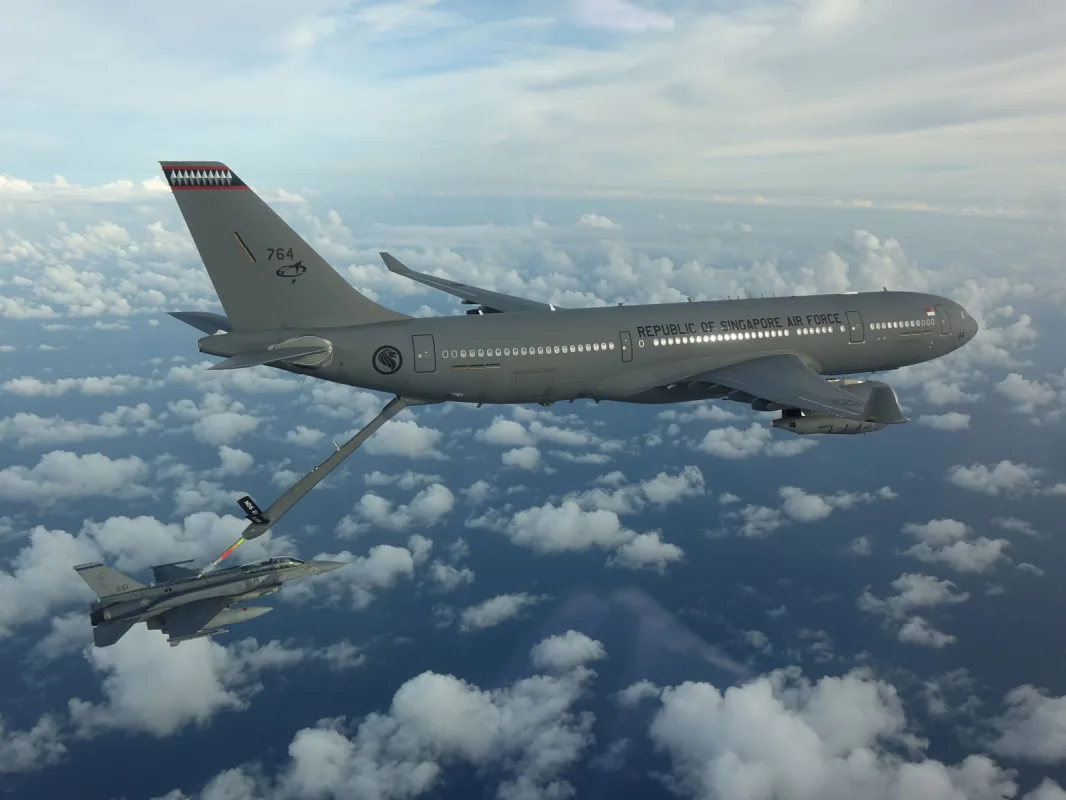

PARIS — Denmark has announced plans to join a European tanker aircraft consortium for in-flight refueling, including the potential purchase of two Airbus A330 MRTT aircraft. It is estimated that Danish participation in this joint capability will cost approximately 7.4 billion Danish kroner (1.1 billion dollars) over the period 2025-2033.
The Danish Defense Chief, Gen. Michael Hyldgaard, recommended that Denmark become a partner in the multinational transport and refueling fleet, initially through the purchase of flight hours for aerial refueling, followed by negotiations to purchase a share in the consortium equivalent to two refueling aircraft, the Ministry of Defense stated on March 25.
Aerial refueling is one of several critical defense factors where Europe partially depends on U.S. capabilities, a dependency that appears increasingly risky as the American government disengages from Europe. The stakes could be even higher for Denmark, given that U.S. President Donald Trump has repeatedly threatened to annex Greenland, a Danish autonomous territory.
The Danish Air Force operates F-16 and F-35 fighter jets.
The tanker capability will strengthen Denmark's air defense and "increase the combat power of Danish defense, including our national operational needs," said Danish Defense Minister Troels Lund Poulsen. "For example, the aerial refueling capability creates the conditions for operations with fighter aircraft in the Arctic and North Atlantic."
The Danish government agreed in February to allocate an additional 50 billion kroner to defense over the next two years, increasing defense spending to more than 3% of GDP in 2025 and 2026.
The multinational tanker fleet consists of nine MRTT aircraft, owned and operated by NATO, pooling resources from the Netherlands, Luxembourg, Germany, Norway, Belgium, and the Czech Republic. The six European countries have ordered an additional tanker for delivery in 2026.
Poulsen said that "there is good potential for Nordic cooperation in this field" of aerial refueling.
The fleet is operated from Eindhoven in the Netherlands, with aircraft also stationed in Cologne, Germany, both about 460 kilometers southwest of the Danish border. The joint tanker fleet was first proposed in 2012 and initiated by the European Defense Agency to address what NATO calls a "long-standing shortfall" in European aerial refueling capability.
The Airbus A330 MRTT is a multi-role aircraft that, in addition to carrying 110 metric tons of kerosene, can also be used to transport passengers or cargo, with a payload capacity of 45 tons. The aircraft can use a boom to refuel aircraft including F-16 and F-35, and a probe and drogue system for Eurofighter, Tornado, F-18, Gripen, and Rafale.
Germany is the largest user of the joint tanker fleet in terms of flight hours, ahead of Belgium and the Netherlands. The fleet began with the Netherlands and Luxembourg jointly purchasing two A330 MRTTs in 2016, with five additional aircraft ordered in 2017 after Germany and Norway joined the project, with further tankers ordered in subsequent years following the entry of Belgium and the Czech Republic.
In addition to the six-nation pool, other A330 MRTT operators in Europe are France with a fleet of 12 aircraft and three more on order, and the United Kingdom with 14 tankers, according to Airbus data at the end of February.
The Danish defense chief also proposes investing about 4.7 billion kroner over the period 2025-2033 to accelerate the construction of the Army's 1st Brigade into a heavy brigade over three to five years, with the construction of two infantry companies, a tactical drone section, a mechanical engineering company, and off-road trucks.
Denmark has announced the establishment of an air defense unit at the Flyvestation Skalstrup military facility, in anticipation of acquiring ground-based air defense systems, according to a separate statement on Wednesday. The country officially decommissioned the air defense units operating the Hawk missile systems at that site in 2005. The government has stated that it will seek an interim air defense solution that can be delivered as early as this year or next year, and will choose the system for a permanent solution this year, with the aim of finalizing the contract by the end of 2025. Earlier this month, Denmark shortlisted the Franco-Italian SAMP/T system and the U.S. Patriot system to cover the high end of the threat spectrum in its air defense system procurement plan, while MBDA's VL MICA, Kongsberg's NASAMS, Diehl Defence's IRIS-T SLM, and the U.S. IFPC are competing for the lower segment.





Comments
No comments yet. Be the first!