


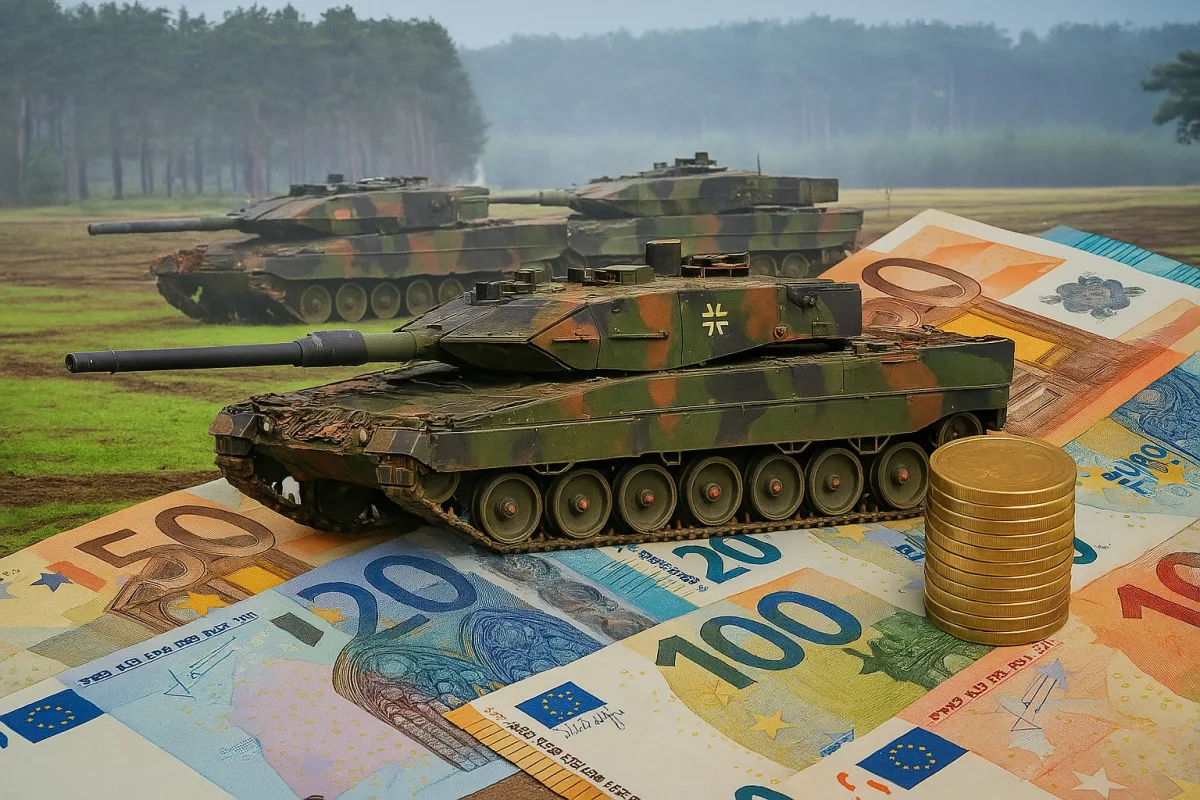

With the war in Ukraine raging since 2022 and Donald Trump's political stance towards NATO, Europe finds itself at a crucial moment for its future in terms of security. The Atlantic Alliance, historically driven by the United States, is now facing an increasing need for reorganization, not only strategically but also financially.
The United States remains the top NATO contributor, with a colossal defense budget of €895.6 billion in 2024 (about $880 billion in 2023). A figure so high that it alone surpasses the sum of the next eight countries in the world in terms of military investments, according to an analysis by Al Jazeera based on data from the Stockholm International Peace Research Institute (SIPRI). This primacy reflects Washington's dominant role on the global stage but also highlights the existing asymmetry among NATO members.

The Global Arms Race
Global military spending reached a record $2.44 trillion in 2023, with an increase of 6.8% compared to the previous year. It is the most significant jump since 2009 and marks the return of competition among major powers. China, with $309 billion, maintains second place, followed by Russia with $126 billion. However, if we look at per capita spending, the proportions change drastically: the United States invests $2,694 per inhabitant, while China spends $208. Israel, with $2,997 per inhabitant, holds the world record. Saudi Arabia, with spending equal to 7.1% of its GDP, reaches $2,052 per capita, a figure comparable to that of the United States.
Among the most extreme cases is Ukraine: in the midst of the conflict with Russia, in 2023 it allocated $62.1 billion to defense, equal to 36.7% of GDP and over half of the total public spending.

Europe Increases Spending, but Lags Behind
In the last ten years, European military spending has grown steadily. Just in the last year, it increased by 11.7% in real terms, reaching €423.3 billion. An increase of 50% compared to 2014, but still insufficient compared to the standards set by Washington. The 23 EU countries that are NATO members have reached spending equal to 2% of the combined GDP in 2024, and it is expected to reach 2.04% in 2025.
However, Donald Trump – in view of a possible re-election – has floated the idea that NATO members should allocate at least 5% of their GDP to defense, a proposal supported by the EU Commissioner for Foreign Affairs Kaja Kallas and also welcomed by French President Emmanuel Macron, who aims for 3.5% of GDP for France.
Big and Small Efforts: Germany, Poland, Spain
Among European economies, Germany saw an increase of 23.2% in military spending between 2023 and 2024, becoming the fourth country in the world for defense budget. Poland, on NATO's eastern frontier, has instead brought its commitment to 4.12% of GDP, becoming the European country with the highest spending-to-GDP ratio, followed by Estonia (3.43%).
But not all European countries are keeping the same pace. Spain has refused to yield to Trump's pressures: it plans to reach only 2% of GDP by 2029, starting from the current €17.5 billion. Italy, with spending of $34.5 billion (1.49% of GDP), remains below the NATO average, investing $603 per citizen, compared to France's $946 and the United Kingdom's $1,106.

A Fragmented Alliance
Today, 23 out of 32 NATO countries meet the 2% GDP target, compared to just three in 2014. But the differences remain marked. If the growth trend in spending were to remain constant, an average of 3% of GDP could be reached within five years and 5% within ten. However, maintaining such rates appears unrealistic, especially without structural reform.
As Jeromin Zettelmeyer, director of the think tank Bruegel, pointed out, Europe must pool military purchases to increase defensive capabilities at sustainable costs. Only through cooperation and industrial integration can the EU strengthen its security without compromising economic stability.





Comments
No comments yet. Be the first!