


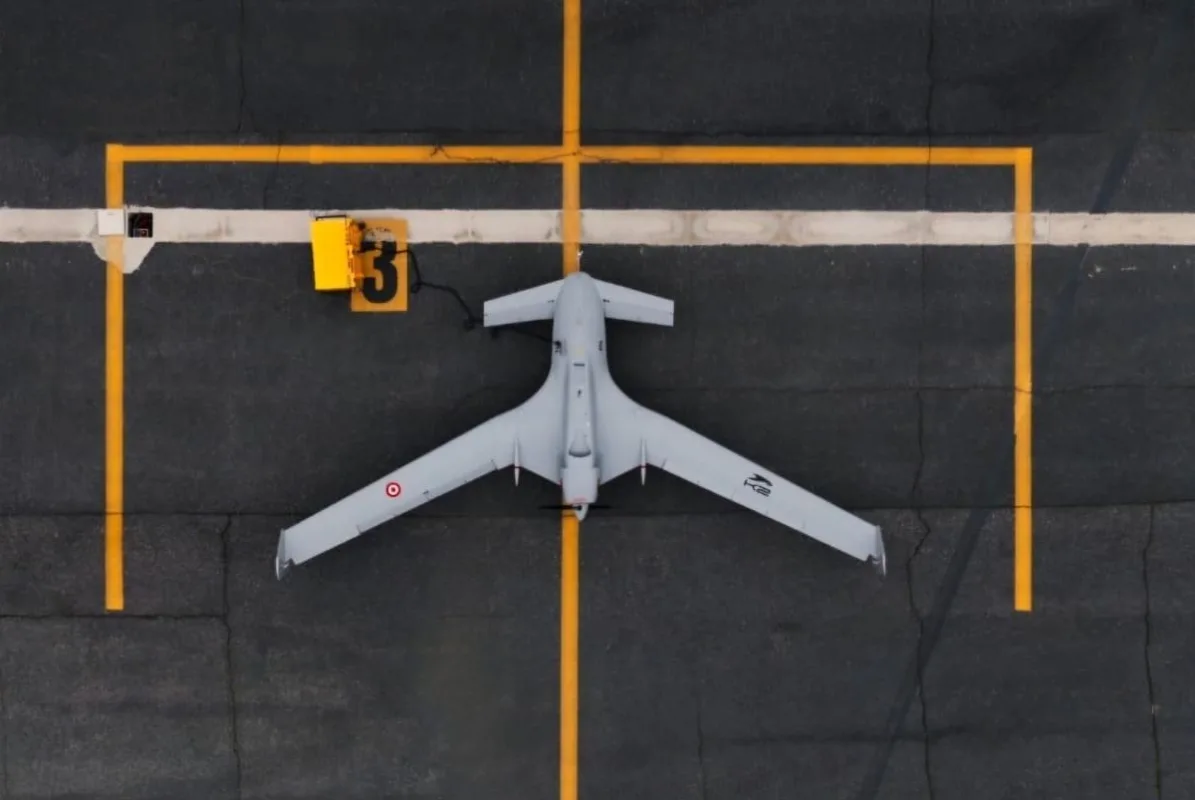

The Turkish company Baykar has unveiled the new K2 Kamikaze UAV, a long-range loitering munition designed to operate in autonomous swarm formations. The debut was accompanied by a series of tests conducted on March 13 and 14, 2026 from the Keşan test center in the Edirne province, with missions over the Gulf of Saros. During the tests, five aircraft performed multiple sorties in various flight configurations, demonstrating the ability to maintain formation thanks to onboard sensors, autonomous software, and artificial intelligence algorithms.
According to the company, the K2 is conceived as a “high-impact” attack platform, yet low-cost and mass-producible, aligning with a saturation and mass logic that is becoming central in contemporary conflicts. The coordinated flight demonstration with five drones suggests that Baykar is not just proposing a new attack UAV, but a system designed from the outset for collective, distributed, and scalable use.

Technical features: large payload, long endurance, and anti-jamming navigation
Technically, the K2 is in a higher category compared to many traditional loitering munitions. Baykar indicates a maximum takeoff weight of 800 kg, a 200 kg warhead, endurance over 13 hours, and a range beyond 2,000 km, with a cruising speed over 200 km/h. The dimensions confirm the scale leap: the drone measures about 5.1 meters in length, 2.1 meters in height, and has a wingspan of 10 meters. These numbers bring the K2 closer to a low-cost deep attack platform than a light tactical loitering munition.
The aircraft also integrates an electro-optical/infrared turret usable for both reconnaissance and surveillance and target acquisition and terminal guidance. A particularly relevant feature is the declared capability to operate in GNSS-denied environments, meaning in the absence or under disturbance of satellite signals: the K2 can continue to navigate using visual terrain reference with its cameras, a function that directly addresses the growing spread of jamming and spoofing observed in recent theaters. Industry sources also report that the system has line-of-sight and beyond-line-of-sight via satellite links, expanding long-distance operational flexibility.

Why it matters: from “kamikaze drone” to long-range saturation
The most interesting aspect of the K2 is not just its range, but the fact that Baykar is attempting to combine autonomy, swarm, significant warload, and low cost in a single architecture. This positions the system in a range that can attract countries interested in deep strike capabilities but cannot afford large stocks of cruise missiles or fleets of dedicated attack aircraft. Several analysts cited by the specialized press believe that the swarm capability itself could increase the K2's export appeal, transforming it from a simple attack drone into a true system-of-systems capability.
However, it is important to note that many of the performances released so far come from the company's statements and promotional test materials. Even so, the industrial and operational message is clear: Baykar wants to enter the heavy and long-range loitering munitions segment with force, at a time when conflicts in Ukraine and the Middle East are showing the value of systems capable of deep strikes, saturating defenses, and maintaining effectiveness even in degraded electronic environments. The company has also indicated a future goal of a variant capable of returning to base after payload release, paving the way for an evolution of the K2 from a “one-way” platform to a reusable system.



Comments
No comments yet. Be the first!