


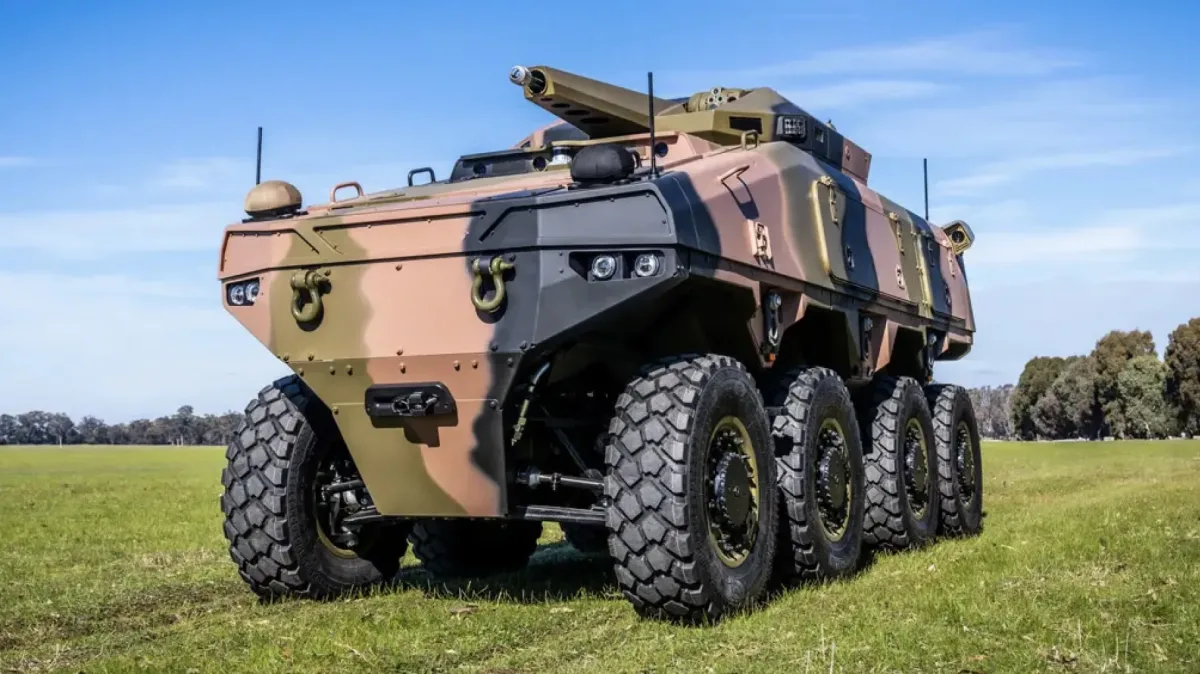

BAE Systems Australia unveiled at Melbourne, during the Land Forces 2024 exhibition, the new ATLAS Collaborative Combat Variant (CCV): an uncrewed ground vehicle (UGV) with 8-wheel drive (8×8) designed to accompany crewed armored vehicles and reduce soldiers' exposure to the most dangerous tasks.
A “modular” UGV with an autonomous vocation
According to the company, ATLAS CCV is designed for a battlefield where man-machine mixed teams will operate, with autonomous and semi-autonomous platforms capable of increasing the combat “mass” and easing the operational load of crewed units. The project revolves around two pillars: modularity (to change roles and update subsystems over time) and autonomy (to move and operate with various levels of human supervision).
In terms of deployment, BAE describes capabilities ranging from real-time remote control to autonomous waypoint navigation, up to path generation with obstacle avoidance in complex environments (such as wooded areas).

Firepower: VANTAGE turret and 25 mm Bushmaster cannon
The most distinctive element is the integration of the VANTAGE Automated Turret System (ATS), a low-profile turret also designed for uncrewed platforms, armed with a 25 mm M242 Bushmaster. The company indicates an effective range of up to 2,500 meters and a “ready-use” supply of 260 rounds, with dual feed to quickly alternate between two types of ammunition.
The doctrinal point is crucial: engagement with the weapon is planned with “human-in-the-loop”, meaning a human operator is involved in the firing decisions.
“Wingman” on wheels: how it can change ground deployment
BAE positions ATLAS CCV as a teammate for tanks, IFVs, and logistical vehicles: a force multiplier that can venture where the risk is higher, performing tasks such as flank escort, reconnaissance, target detection/engagement, and fire support in favor of crewed units.
The 8×8 chassis is chosen to balance mobility and speed and, above all, to favor deployability: ATLAS CCV is designed to be transportable in a 20-foot ISO container (or equivalent flat rack), as well as by air or sea depending on available carriers.
Developed in Australia, with a “system” ambition
The program is presented as a product with a strong Australian imprint and also oriented towards the domestic market: the vehicle was shown with liveries reminiscent of the Australian Army and fits into Canberra's growing interest in uncrewed systems (so far more visible in air and sea, but also expanding on land).

Quick facts: ATLAS CCV in summary
- Type: “collaborative” uncrewed ground vehicle (UGV)
- Configuration: 8×8, modular platform
- Mass: approximately 10–11 tons (variable depending on load/payload)
- Main armament: 25 mm M242 Bushmaster on VANTAGE ATS turret
- Ready-use ammunition: 260 rounds, dual feed
- Autonomy: remote control + autonomous waypoint navigation + obstacle avoidance / path planning
- Engagement: human operator in the decision loop (human-in-the-loop)
The context: a race for “medium” UGVs
ATLAS CCV arrives as several armed forces are experimenting with armed UGVs intended to operate in pairs or teams with crewed vehicles. The underlying idea is to replicate on the ground concepts similar to the “loyal wingman” in the air domain: uncrewed platforms employed for high-risk tasks, advanced reconnaissance, flank protection, and selective engagements, reducing personnel exposure.

What to expect next
The next step involves the maturation of the demonstrator: testing, integration of sensors and communication systems, verification of control modes and cooperation logic with crewed units. The direction is clear: increase field effectiveness while maintaining human control over weapon deployment decisions, and leverage modularity to adapt the UGV to different missions (escort, reconnaissance, logistical support, and fire support).
If you mean “internal links” also as references like “as you can read here” or similar phrases, let me know and I will further clean them up in a completely neutral style.


Comments
No comments yet. Be the first!