


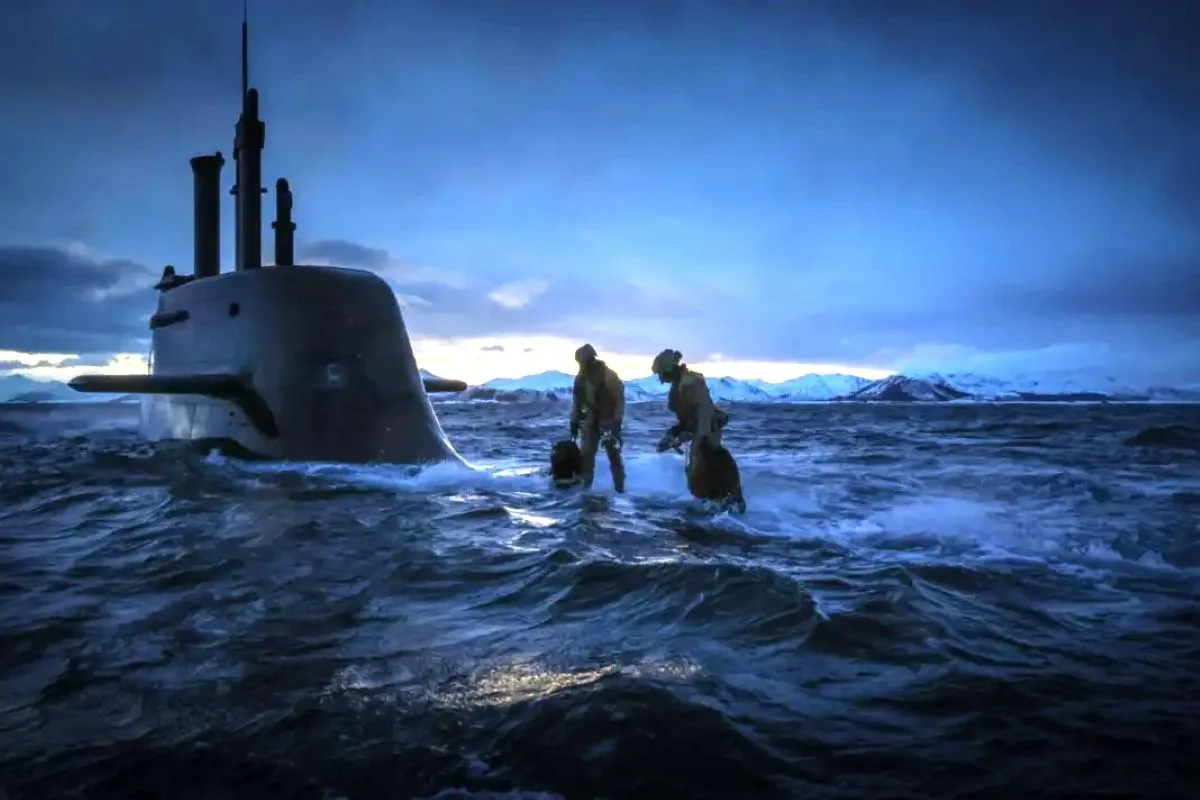

In preparation for Cold Response 2026, one of NATO's main exercises in the Arctic area, the British Royal Marines conducted a maritime infiltration activity on March 3 from a German Type 212A submarine in Norwegian waters. The operation, announced by the Royal Navy, is part of allied initiatives aimed at strengthening operational readiness in the so-called High North.
According to reports, personnel from the Commando Force were deployed from the German submarine U-35 while submerged to carry out advanced reconnaissance, coastal surveillance, and target acquisition missions in support of subsequent NATO operations.
The assets involved include elements of the 30 Commando Information Exploitation Group, particularly the Surveillance and Reconnaissance Squadron (SRS) and the Shore Reconnaissance Troop (SRT), along with observers from the 148 Commando Forward Observation Battery. These are specialized capabilities used to penetrate sensitive areas, gather tactical intelligence, and prepare the engagement of targets through naval gunfire or close air support.

Coastal reconnaissance and target designation
In the simulated operational profile, the British teams operated along the Norwegian coast with the task of identifying and monitoring a simulated hostile radar, subsequently engaged by Alliance naval units. Such activities are aimed at improving maritime situational awareness and neutralizing sensors and nodes of the adversary's network before the start of larger-scale operations.
Submarine infiltration represents a highly complex mode of deployment but offers significant advantages in terms of discretion, survivability, and access capability to heavily monitored coastlines. According to the Royal Navy, the use of a German underwater platform was determined by the absence, at this stage, of a British submarine available for the mission.

Cold Response 2026
The episode is part of the preparatory activities for Cold Response 2026, an exercise led by Norway scheduled from March 9 to 19, with the participation of about 25,000 military personnel from 14 countries. The training involves the integrated use of land, naval, and air forces in Arctic and sub-Arctic environments, with particular attention to conducting operations in extreme climatic conditions.
The main objective is to verify NATO's ability to operate effectively on the northern flank, testing logistics chains, multinational interoperability, command and control, and combat support in a highly complex environment.
Alongside the strictly military dimension, the exercise also includes aspects related to the concept of Total Defence, which in the Nordic countries involves the coordinated involvement of armed forces, civil authorities, and critical infrastructures in response to crisis or conflict scenarios.
The strategic centrality of the Arctic
The increase in NATO activities in the far north reflects the growing strategic relevance of the Arctic from both geopolitical and military perspectives. The progressive melting of ice makes new maritime routes and potentially resource-rich areas more accessible, increasing the interest of regional and extra-regional actors.
On the military front, the role of Russia remains central, particularly the Northern Fleet, which continues to represent one of Moscow's main strategic projection tools in the Arctic and North Atlantic theater. The region is also traversed by maritime communication lines, submarine cables, and energy infrastructures of critical value for Euro-Atlantic security.
In this context, London and other allies are progressively strengthening their operational presence in the sector. The United Kingdom, in particular, views Norway as an advanced hub for training and positioning forces suitable for combat in cold environments.
The infiltration of the Royal Marines from a German vessel confirms, in this framework, both the level of interoperability achieved among allies and NATO's growing focus on specialized operations in the Arctic-maritime domain.



Comments
No comments yet. Be the first!