


Our job does not involve calm situations. There are other organizations for that.
Sergeant Major Paratrooper Giampiero Monti 183rd Paratrooper Regiment “NEMBO”
Wounded in combat on July 2, 1993, and awarded the silver medal for military valor.
Introduction by the Webmaster
Reconstructing the events of July 2, 1993, was not easy. Not easy at all.

I believe I have reached, after over 20 years of research and with the collaboration (of course) of those who lived through that battle, a version very close to reality.
Of those who truly experienced it, because as General Paolo Riccò says in his book The Black Devils. The True Story of the Battle of Mogadishu, the imperial road should have been "the highway of the sun" if we count one by one all those who claim to have fought there.
The whole world, in words, fought at pasta, over the years I have heard stories from people who had never even been to Somalia...
However, during my research, I discovered that many things and many versions published here and there were far from reality.
There is a version published at the time in a well-known military-oriented monthly, thus the most authoritative of the era, and also spread on the web that even got the timing wrong by reversing the chronology of the first two casualties.
Obviously, many things are missing in the reconstruction, that goes without saying. But before writing important details, I made sure they actually happened. Many things that day did not work properly.
However, it must be remembered that we were "fasting" for fifty years, so it seems physiological to me... the last clash of such proportions the Italian military had was at the end of World War II.
Despite everything, even that day, the Italian Paratroopers and the military involved with them upheld the Italian Military Honor showing that they could bend, yes, but never break.
But what really happened on July 2, 1993?
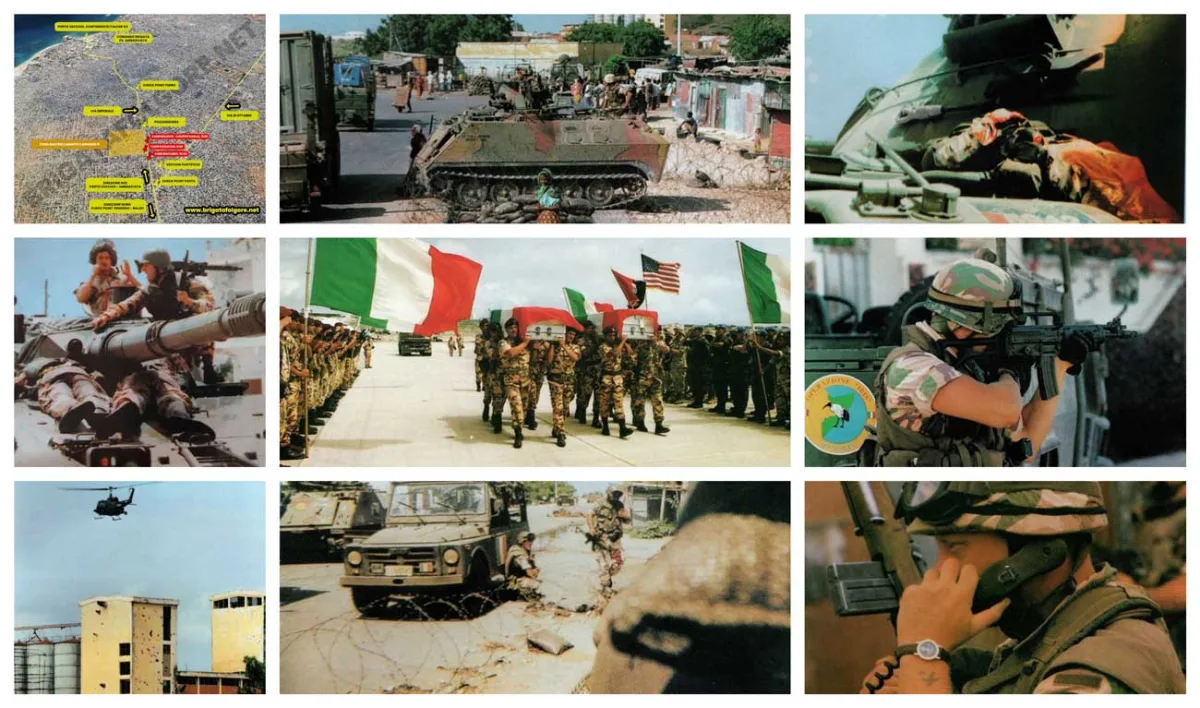
Let's take a closer look. It's 5 in the morning on a hot summer Friday. It's July 2, 1993, and we are in Mogadishu, Somalia, mission IBIS and the Alfa and Bravo groups under the command of General Bruno Loi are ready to carry out yet another sweep.

Until June 1993, the Italian contingent had thoroughly swept the entire area under its responsibility, but the large Aliwa area was still missing, a neighborhood through which the Italians continuously passed having the Brigade command in Mogadishu, in the former Italian Embassy, in addition to the Italfor XX command at the old port while the largest camp was in Balad, northbound.
Mogadishu and Balad are connected by the imperial road, an artery that starts from the sea and reaches Addis Ababa, in Ethiopia. Built by the Italians in the 1930s, the imperial road is the most important communication road in Somalia and along its route, the Italians manned numerous checkpoints: bank, obelisk, national, demon, iron, pasta.
The check point pasta located at the intersection of imperial road and October 21 road is named after an old abandoned pasta factory that overlooks the vast Aliwa neighborhood, in the heart of Mohamed Farah Aidid's territory.
I began to document the Battle in 1998 when I learned about it from a friend, a Marshal from the 11th Leonessa Transmission Regiment present that day in the Somali capital.
I started gathering as much information as possible, both in print from books (in truth few at the time, and still few now) and electronically with the help of the internet.
Subsequently, enlisting in the Folgore Paratrooper Brigade I was flattered to come into contact with those who had truly fought that Battle.
In Mogadishu, two furious battles were fought during that time: the one on October 3, 1993 (from which the film Black Hawk Down is derived) involving American soldiers from the 75th Rangers and Delta Force, and indeed the one on July 2, 1993.
In recent years, information has emerged that almost completely completes the puzzle of July 2.
But the most important information remains a mystery: it is still not officially known, and we will probably never know, why the Somalis reacted in that way. It seems that an Italian Intelligence team had located it, but it was not the Italians' intention to capture him.
Certainly not by the Paratroopers deployed by General Loi. Their task was “only” to sweep the pasta factory area, to complete operation Kangaroo 11. The Paratroopers had seized a large quantity of weapons and ammunition, that was their task that day. Kangaroo 11, in a sense, had completed its mission. What happened next was not foreseen in the operation. However, hell, in these cases, is always around the corner.
But as always, wounded in spirit, the FOLGORE was not defeated that day either. Wounded, offended, but not defeated.
5:00 AM: the sweep begins
Dawn of July 2, 1993, operation Kangaroo 11 is about to start. It is 5 in the morning and from Balad the Italian convoy begins to move towards Mogadishu.
General Loi deploys an impressive force: 550 Paratroopers and 400 Somali policemen, transported aboard VCCs and Fiat 6614s.
To support them, eight B-1 Centauro armored vehicles from the Montebello Lancers and seven M-60 tanks from the 132nd Ariete. The operation, divided into two groups, Alfa and Bravo, is followed from above by A-129 Mangusta combat helicopters and AB-205s.
The dusty streets of the Somali capital are overshadowed by the tracks of the Italian vehicles and, having passed Check Point Pasta, the Italian soldiers take position within the target area, a quadrilateral of 400 by 700 meters between "Pasta" and "Ferro", an Italian stronghold in a neighborhood inhabited by Aidid's "Ha-ber-ghidir" tribe. The teams disembark from the vehicles and the Paratroopers isolate the area. Other teams, supported by the Somali police, begin house-to-house searches for weapons.
The tension between the two major Somali leaders, Aidid and Ali Mahdi, is extremely high and the warlords do not seem inclined to end the continuous clashes, and there is a risk that at any moment clashes with the multinational contingent could ignite. This is precisely why the deployment put in place by General Bruno Loi is impressive.
Our soldiers know they are on a peace mission, but also that a peacekeeping operation between two factions hides significant pitfalls. No one wishes for it, but anything can happen.
The sweep is almost complete. The Paratroopers, around 6:30, find a large weapons depot: three Somalis are arrested and taken to the base for questioning. But right at this moment, the situation escalates. Tension begins to mount and the first shots are heard in the air, without understanding where they come from.
The first casualty

Just a few dozen meters remain to complete the sweep, and suddenly the Somali policemen disappear.
There is something differently tense in the air. A previously solid balance, the foundation of friendly relations between Somalis and Italians, seems to have suddenly broken, giving rise to an unexpected wave of tension.
It is Friday, July 2, 1993, and it is 7:40 in the morning when, unexpectedly, the neighborhood's inhabitants begin to pour into the streets, hurling insults at the Italians. The first barricades become the stage for intense stone-throwing and sporadic gunfire.
Today there is something different in the air. A previously solid balance, the foundation of friendly relations between Somalis and Italians, seems to have suddenly broken, giving rise to an unexpected wave of tension. It is Friday, July 2, 1993, and it is 7:40 in the morning when, unexpectedly, the neighborhood's inhabitants begin to pour into the streets, hurling insults at the Italians. The first barricades become the stage for intense stone-throwing and gunfire.
The Italian paratroopers try to remain calm; General Loi, in an attempt to regain control of the territory, orders warning shots. However, every attempt seems in vain, with the tension intensifying at times. For the Italian contingent, the episode ends here, perhaps as a warning: the atmosphere is changing, even for the Italians.
But suddenly, the last part of the Italian column finds itself blocked by new barricades, and the troops are caught in crossfire.
The militiamen hide among the crowd, in houses, on rooftops. This time it is a real armed clash. The previously existing harmony between Italians and Somalis has definitively shattered. After fifty years, Italy finds itself involved in an armed conflict, in what was supposed to be a peacekeeping mission.
The raiders of the Col Moschin rush in. The third company of special forces sends two detachments of paratrooper raiders. Their task is to flush out the Somali snipers and unblock the column pinned down under enemy fire.
A violent fight begins with bursts of SCP and grenade explosions. During the umpteenth assault, at around 9:30, Sergeant Major Raider Stefano Paolicchi is hit by a burst of Kalashnikov fire. He had just destroyed a mortar position with a precise throw of two OD-82 grenades.
Hit at the spleen level, in the only part not protected by the bulletproof vest, he will shout, on the verge of death, to his team members to keep fighting. Transported to the Mogadishu hospital, he will die a few hours later.
He is the first victim of July 2nd.
Back to pasta
At this point, General Loi orders the Bravo group, which had meanwhile almost reached Balad, to reverse course and return to Mogadishu, heading towards pasta to defend it from potential attacks: the men on duty at the garrison are left alone. Captain Riccò, commander of the XVª Black Devils Company of the 186th Par. Rgt. Folgore, will recount in his book, had already noticed it during the retreat.
A column of vehicles is then created, composed of three AR76s that would lead the way, followed by as many VCCs and two Centauro armored vehicles. Serg. Maj. Monti asks to return to the Pasta Factory with his team. His Paratroopers follow him voluntarily, among them Massimiliano Zaniolo. No one refuses to participate in the operation.
The column composed of the Paratroopers of the XVª of the 186th Rgt. and XIIª of the 183rd Par. Rgt. Nembo is approaching hell.
Eyes open, round in the chamber, and they reach along the Imperial Road. Further ahead, near an intersection, there is the pasta checkpoint, so called because it was set up near an abandoned pasta factory.
The road is initially deserted, on the sides of the roadway the remains of barricades and some burning cars, the echoes of gunfire can be heard in the distance. Beyond the intersection, there is an obstacle. Upon reaching "pasta," the situation seems "calm," but three hundred meters ahead, barricades are rising. Others are being built behind the column.
Trapped
Captain Riccò realizes he is trapped. He then takes the initiative and, with his Non-Commissioned Officers and Paratroopers, tries to clear the area by flushing out the Somalis one by one, house by house, roof by roof.
They are now in full combat. The Italian Paratroopers gain ground, but more Somalis keep arriving. It is evident they are trying to surround them.
The armored vehicles are positioned in a staggered manner along the Imperial Road to ensure effective crossfire.
Second Lieutenant Romeo Carbonetti on the first VCC, and Paratrooper Pasquale Baccaro on the second, fire with the MGs, clearing everything in front of them. Serg. Maj. Giovanni Bozzini, on the other hand, wields the Browning on the third VCC. The armored vehicles begin to advance, gaining meters.
However, more Somalis arrive, also firing from the pasta factory. One of the VCCs, that of the young Second Lieutenant Romeo Carbonetti, which exposes its side to that source of fire, becomes a magnet for bullets. Now it is the Italians who find themselves under crossfire.
Then, in an instant. An instant that changes everything. The life and future of a group of young soldiers. It is 10:40 on July 2nd, 1993.
From a side street comes a deadly shot. An RPG-7 hits the second VCC and the shaped charge pierces the armor, hitting it right above the top of the track. These are moments that seem like long years. Serg. Maj. Bozzini immediately jumps from the VCC, inside the vehicle it is hell: the hatch suddenly opens and the first wounded come out, Paratrooper Massimiliano Zaniolo first, with a devastated hand, behind him Serg. Maj. Monti with a slashed abdomen and deep leg wounds. But the worst is for Paratrooper Pasquale Baccaro at the MG: he has a leg torn apart by the fiery dart generated by the anti-tank rocket. He is laid outside the vehicle, still alive, but loses consciousness.
The wounded are laid in a nearby safe area. However, Captain Riccò is convinced that if he could quickly evacuate the wounded, Baccaro might be saved, perhaps they could even reattach his leg.
Now, however, they must continue to defend themselves and counterattack because the Somalis, galvanized by the RPG hit, are closing in. They intensify the assault, the shots ricochet off the recently hit VCC, which is still exposed to the militiamen.
The vehicle is restarted with difficulty, then removed from the position to avoid being hit again by anti-tank rockets.
Minutes pass, ambulances and rescue teams are blocked by heavy enemy fire and barricades.
A military helicopter tries to land nearby to pick up the wounded. The positions are marked with red smoke, but there's no chance: it will try twice, but will be heavily targeted by Somali fire and will have to retreat to the base.
One must act alone to get out of the situation.
However, a very serious incident occurs from a military point of view:
Captain Riccò notices that his AR76 is moving away along with other vehicles including the Centauro armored car towards Pasta. The Battalion Commander and the Commander of the XIIª Leopardi Company were slightly injured by the wave of shrapnel produced by the rocket on the armor of Baccaro's VCC. Therefore, the Battalion Commander considers a retreat to Pasta taking away a good part of the vehicles and men, WITHOUT INFORMING THE XVª Company. Now the Black Devils are alone, without radio, placed on the AR76 (the one on the VCC communicated on different frequencies) and without the support of the Centauro armored cars.
It is approaching 11 in the morning and the fighting continues incessantly.
The Paratroopers of the XVª Company fire in bursts with their assault rifles and throw grenades to prevent the Somalis from gaining the upper hand.
Meanwhile, Captain Riccò is already thinking about how to retreat. They are left alone, unable to communicate via radio and with several wounded, including Paquale Baccaro in critical condition.
But there is no more time for the young Apulian Paratrooper: he will die in his arms within a few minutes while trying to give him water.
He was 21 years old. He is the second victim of July 2nd. Now, however, evacuation is necessary and quickly. The situation is increasingly dangerous.
Retreat to Pasta
The hit vehicle is restarted, the wounded are loaded on board, and the unit leaves the ambush site while the entire neighborhood is now in revolt.
The Black Devils of the 186th Regiment finally reach Pasta where they also find the Regiment Commander and other Paratroopers. No one knows about the clashes and losses suffered.
But chaos reigns supreme at Pasta. There are too many vehicles and men concentrated in one space. So much and too much confusion.
In these moments, there is a whirlwind of abrupt maneuvers, gunfire, shouted orders. And all within reach of the Somali militiamen who are about to complete the encirclement. Fighting occurs everywhere along the Imperial Road, shots are fired from side streets, particularly from the pasta factory.
Meanwhile, Second Lieutenant Gianfranco Paglia boards the VCC driven by Paratrooper Renzo Polifrone and takes away the last wounded from Pasta with the order not to return.

A few dozen meters away, Paratroopers Giuseppe Zivillica and Marco Vicenzetto have been wounded by Somali fire.
They are losing a lot of blood and cannot move: they lie on a Centauro armored car commanded by Second Lieutenant Fabio Tirolo of the 8th Montebello Lancers Regiment.
Paratrooper Captain Emilio Ratti observes the scene and, despite having received orders not to move and to await instructions via radio, decides to use the armored vehicle to evacuate the wounded: Second Lieutenant Tirolo refuses. He too has been ordered to stay there.
But Captain Ratti is not having it. He gives an even more peremptory order, as Tirolo reported in a recent interview in a television documentary, with these exact words: "Knight, there are two things, either you take these Paratroopers to safety or I'll shoot you". Only then does the vehicle start moving, encountering numerous barricades and gunfire.
Meanwhile, the Italian soldiers at Pasta are completely surrounded.
The A-129 MANGUSTA helicopters and armored vehicles request permission to use their weapons.
If the 105/51 mm of the M-60s and the 105/52 mm of the Centauro armored cars were to come into action and if the helicopters could fire the TOW missiles, the task of the ground troops would be facilitated and the siege broken with less risk for the IBIS soldiers.
But General Loi does not feel like risking a massacre. Cannon shots among the houses would surely cause a slaughter involving innocent civilians as well. The authorization to open fire does not come. "Identify and neutralize the fire centers" responds the Command.

This is a very risky job that can only be entrusted to professional soldiers. Snipers and positions are reported from the ground and helicopters. The QRF arrives on the VM consisting of operators from the Col Moschin, who have the most difficult task, to silence mortars and rocket launchers by attacking them with individual or team weapons, but without the support of heavy weapons.
Two detachments of commandos scour all the alleys parallel to the imperial road, eliminating all the militiamen one by one.
A house-to-house combat develops against the lurking militiamen.
During a disengagement, Sergeant Major Stefano Ruaro, Paratrooper Commando, is hit in three parts of the body in the lower limbs by a burst of Kalashnikov while driving his VM.
He loses a lot of blood and has deep wounds on his legs and an arm, but he hides behind a vehicle allowing his comrades to continue fighting.
In the total chaos, with bullets flying everywhere, the Commandos leave a VM90T with the ignition keys inserted. The special forces were the only ones to have this type of vehicle with the Browning 12.7 on the mount. A group of Somalis seizes it.
The militiamen board the jeep, cheer, flee with their loot, and fire the powerful machine gun at the Italians. They immediately hit an AB 205 helicopter which will be forced to return to base.
However, they are spotted by an A-129 Mangusta attack helicopter piloted by Captain Gianni Adami. The pointer targets them and requests permission to fire. Curses echo in the intercom, now the jeep disappears into the maze of alleys in the neighborhood.
But the helicopter pilot does not give up the prey. He flies low, skimming the rooftops, and despite being aware of the risk of being shot down, he engages in close combat. The Somalis react violently: they swing the large machine gun and hit the helicopter on the front glass.
The officer does not give up. The vehicle seems to disappear, but it's only a moment: it is sighted again and this time targeted to be shot down. That VM, it will be known later, carries several kilograms of C-4 explosive inside, supplied to the Commandos of Col Moschin.

The A-129 tilts, targets the objective, requests authorization to fire. The "Ok" comes. The pilot does not hesitate. The TOW missile hits it and, aided by the presence of explosives on board, completely disintegrates it, killing all the occupants.
Around pasta the fighting continues relentlessly.
From the old port a column of vehicles forms to reach pasta again: a VCC-1 of the TUSCANIA Paratrooper Carabinieri Battalion, one from the 186th Regiment with the pilot, Paratrooper Polifrone, and Second Lieutenant Paglia on board, and a CENTAURO armored vehicle of the 8th Montebello Lancers Regiment. They surpass iron and rush at full speed on the imperial road.
Some obstacles stand in their way, more shots are fired, and the Italian vehicles break through the barrier with momentum. Second Lieutenant Andrea Millevoi is the crew chief of the CENTAURO, coordinating the action, he leans out of the turret to better control the situation. He is hit by a burst and dies instantly.
It is 11:30 and he is the third victim of July 2. Almost simultaneously, Second Lieutenant Paglia is also hit.
Five minutes killing zone
The Tuscania's armored vehicle has already disengaged on the imperial road so that Polifrone's VCC and the Centauro armored vehicle arrive alone at pasta with one fallen officer (Millevoi) and one seriously injured (Paglia). Captain Riccò cannot believe his eyes: he had asked Paglia to stay at the old port, yet he finds him on the verge of death laid in the vehicle. He orders the additional wounded to be loaded onto the armored vehicles and instructs one of his second lieutenants to head back to the old port and not to return to the combat zone. This time the order is more peremptory and so it will be.

The Italians, however, are progressively disengaging. The raiders have created a security perimeter, but everything is very precarious. The militiamen receive new reinforcements and the Italian vehicles retreat on the orders of the Command, but from some positions, Aidid's men threaten the column.
The command continues to not allow the use of heavy artillery.
The response, however, comes from the sky: two Cobra helicopters from the U.S. contingent fly over pasta. Over the radio, you hear "Five minutes killing zone".
Five minutes and everything within the range of the Cobras is a target to be taken down.
The Italians, some truly convinced they would never get out of that situation, look up and notice the Cobras hovering in front of the pasta factory.
A few minutes later, fire at will. The old pasta factory is hit by missiles and 20mm bullets. It's time to leave pasta.
A column is formed, heading south, old port, through the imperial road, where the battle still rages. The armored vehicles charge through it, while Captain Riccò, along with Sergeant Major Bozzini, will have to fight yet another battle within the battle before reaching the old port with the battered Fiat AR76.
It's around 1:00 PM and the Italians abandon the area and the checkpoints pasta and iron. Keeping them in those conditions would mean unleashing a pitched battle with the Somalis. The toll is tragic, with three Italian casualties and twenty-three wounded.
But Aidid cannot claim victory. He paid a high price to the UNOSOM troops, with 187 dead and more than 400 wounded in the clash, proving that the action of the Italian military, although severely limited, was effective.
From July 2 onwards, nothing in Mogadishu will be the same.
Comments (2)