


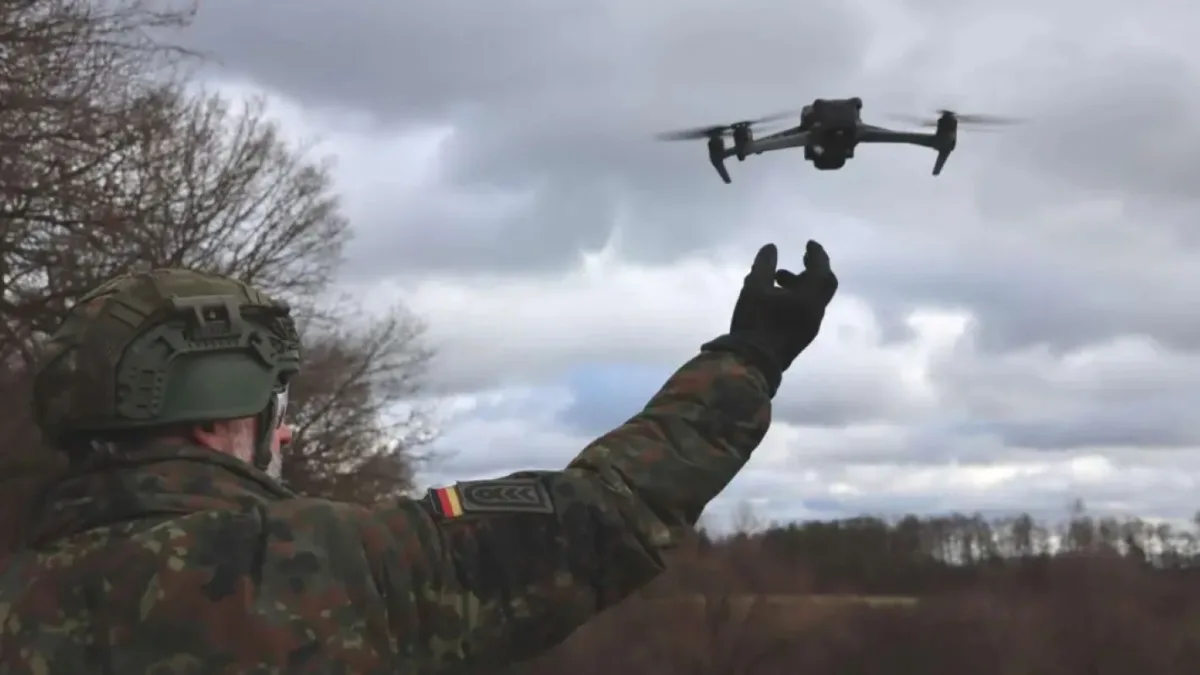

For years, it was the Western armies that trained Kyiv's soldiers. Today, however, the relationship is reversing. Germany has decided to welcome Ukrainian military instructors into the Bundeswehr schools, recognizing that the experience accumulated by Ukraine on the battlefield represents one of the most valuable sources for preparing Europe for a high-intensity conflict.
The decision stems from an increasingly widespread assessment among European military leaders: the war fought by Ukraine against Russia has produced an enormous amount of tactical lessons, operational innovations, and immediate adaptations that no other Western army possesses in such a concrete form. It is not just about theory or simulations, but about daily practice developed under real pressure, in a scenario dominated by artillery, armored vehicles, military engineering, digital command and control, and especially drones.
For Berlin, the message is clear: if the goal is to make the Bundeswehr ready by 2029, Germany cannot just increase spending or purchase new weapon systems. It must also absorb a more modern, flexible combat culture closer to the reality of the front. In this sense, the arrival of Ukrainian advisors and instructors represents a step of great political and symbolic value: Kyiv is no longer just a country to support, but a partner capable of teaching.
This role reversal also has a deeper meaning. After years in which NATO transferred skills to Ukraine, today it is Ukraine itself offering Europe a form of military know-how born from direct experience against Russia. It is the recognition, implicit but very strong, that modern warfare is being studied on Ukrainian battlefields much more than in the traditional manuals of Western academies.

The 2029 Factor: Preparing Now for a War That Could Come Soon
The reference to 2029 is not accidental. In Western security analyses, that date is increasingly indicated as a possible strategic deadline by which Russia could rebuild sufficient capabilities to directly threaten NATO's eastern flank. For this reason, Berlin believes it has no time to lose.
Germany is already accelerating the strengthening of its land forces and aims to build the core of the most robust conventional army in Europe. But the German leadership knows that it is not enough to have more men, more means, and more funds. Above all, it requires preparation that adheres to the characteristics of contemporary warfare, which in Ukraine has shown a very different face from that imagined by many past plans.
The current war is increasingly marked by speed, adaptation, and integration between different systems. Units on the ground must react very quickly, connecting information, sensors, drones, and indirect fire in a continuous cycle. Ukrainians have developed this capability often in a makeshift but extremely effective way, turning urgency into military innovation. It is precisely this approach that interests the Bundeswehr: not only to learn individual techniques but to incorporate a new operational mindset.
In this perspective, the cooperation between Berlin and Kyiv is also a sign of a security relationship that has become more equal. Germany continues to be one of Ukraine's main European supporters, but at the same time recognizes that it has much to learn. It is an important step in the strategic transformation of the continent: Europe no longer looks at Ukraine only as an advanced line of defense, but as a laboratory from which to extract essential lessons for its own future deterrence.

From Berlin to Washington: Ukrainian Drones Enter the Western Strategic Debate
The centrality of the Ukrainian experience does not stop at Germany. In the same days that Berlin opens the doors of its military schools to Kyiv's instructors, Washington also looks with growing attention at the wealth of knowledge gained by Ukrainians, particularly in the drone sector.
According to a recent report by Defense News, commanders and experts from some of the most renowned Ukrainian units specialized in unmanned warfare will be present in the U.S. capital to discuss with policymakers and defense officials the lessons learned on the field. The fact is extremely significant: Ukrainians are not invited as mere witnesses of the war, but as interlocutors capable of explaining how UAVs have transformed combat, reconnaissance, target acquisition, and even the way to wear down enemy defenses.
The Ukrainian presence in Washington reinforces a point now evident also in Berlin: the dominance of drones is no longer a marginal or specialized sector, but one of the central axes of contemporary warfare. Ukrainians have been able to integrate adapted commercial drones, dedicated military systems, low-cost precision attacks, and very rapid decision-making processes. This model interests the United States for technological and strategic reasons, but it interests Europe even more, which must translate these experiences into doctrine, industry, and training.
This is where the two plans, German and American, intersect. Berlin wants to use Ukrainian lessons to prepare the Bundeswehr for a possible future confrontation with Russia. Washington wants to understand how to adapt its defense apparatus to the revolution triggered by drones and new forms of distributed warfare. In both cases, the core of the discourse is the same: Ukraine has become a producer of strategic knowledge.
Ultimately, the real change is not just that Ukrainian soldiers will train German military or that Ukrainian experts will speak in Washington. The deeper change is that a growing part of the West has understood that the military superiority of the future will depend on the ability to quickly learn from those who are fighting today. And today, in the field of high-intensity warfare, drones, and operational adaptation, the Ukrainian lesson appears to be one of the most decisive.



Comments
No comments yet. Be the first!